
SATA DOM for Outdoor Video Surveillance NVRs: Extreme-Temperature Boot Dependability
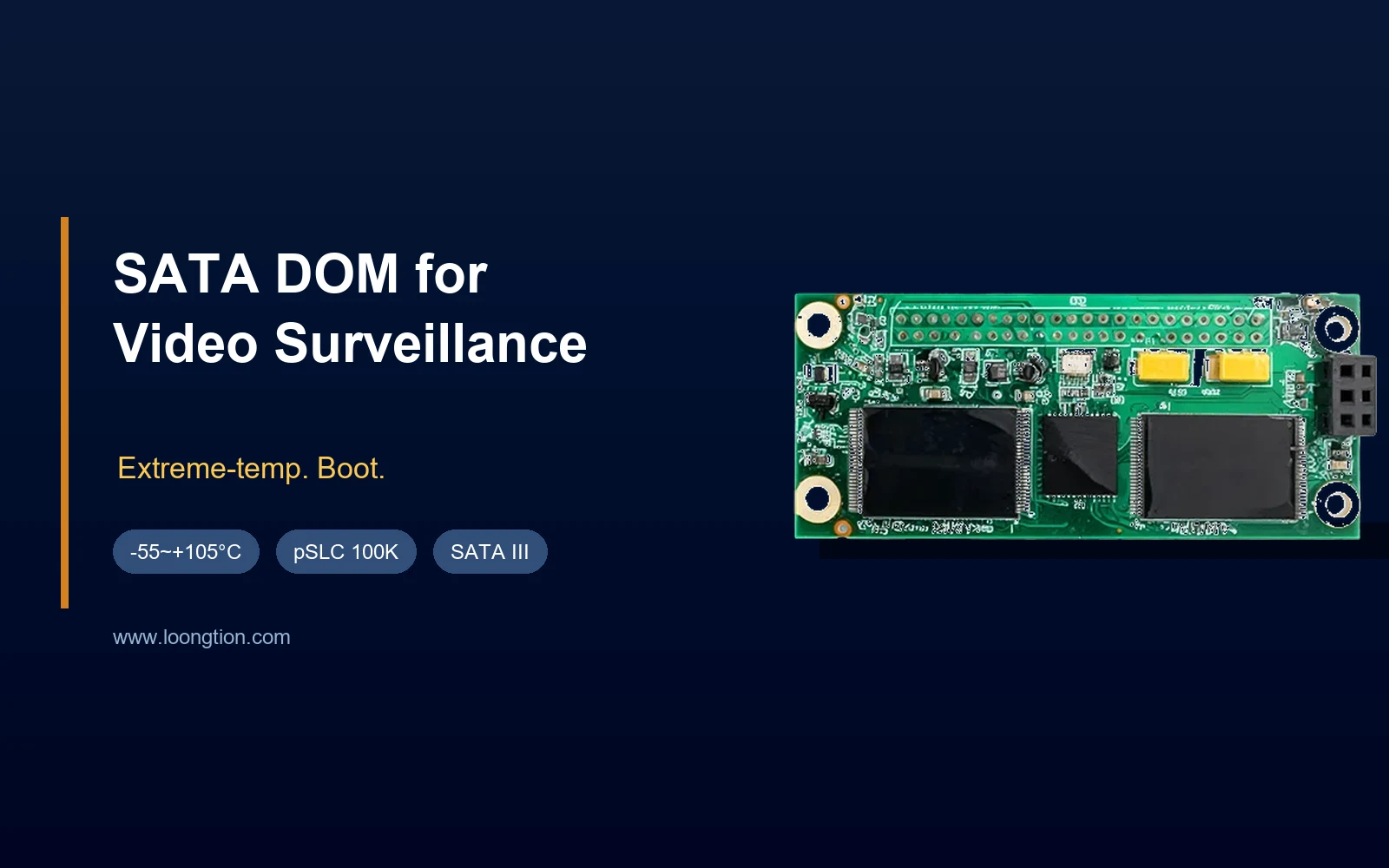
Highway cameras, sealed NVR boxes, continuous recording in -30°C to +55°C. Why an extreme-temperature SATA DOM (-55°C to +105°C, pSLC 100K endurance) is the right boot drive, with fit notes for Innodisk/Kontron/Apacer replacements.
Scene
A highway surveillance camera posts stands in the open, thirty metres from the nearest shelter. Its NVR — a compact industrial computer — sits inside a weatherproof box that bakes in the sun and freezes at night. The recorder writes video frames continuously, 24/7, and the footage is evidence: when an incident happens, the storage must have been working.
Video surveillance NVRs in outdoor deployments face a storage challenge that consumer NAS drives never see: continuous sequential writes in an enclosure with no active cooling, in ambient temperatures from -30°C to +55°C, for months without maintenance. The boot drive, in particular, must be absolutely dependable — because a failed boot means no recording at all.
Why SATA DOM for the boot drive
Many industrial NVR designs use a small SATA disk-on-module as the boot drive — it is compact, uses a standard SATA interface, and fits directly onto the SATA connector without cabling. The choice of NAND and temperature grade decides whether that boot drive lasts five years or five months.
Consumer-grade boot drives use TLC NAND rated for a few thousand program/erase cycles and a 0°C to +70°C operating range. In a sealed NVR box in the sun, the temperature is the first problem; the write endurance is the second — because an NVR writes its operating system logs and temporary files constantly.
Loongtion's SATA DOM (YIDP/YIDQ series) is rated for -55°C to +105°C extreme temperature operation — beyond what most competitors offer, who typically stop at -40°C to +85°C. The pSLC variant (YIDQ) delivers roughly 100,000 program/erase cycles — about 30 times the endurance of TLC — which suits an NVR boot drive that is written continuously over a multi-year service life.
The Loongtion SATA DOM option
| Competitor series | Loongtion equivalent | Temperature gap |
|---|---|---|
| Innodisk SATADOM | YIDP / YIDQ | Competitor -40°C~+85°C vs Loongtion -55°C~+105°C |
| Kontron KSSDS / KCDSK | YIDP / YIDQ | Same gap |
| Apacer SDM | YIDP / YIDQ | Same gap |
Key specifications:
- Interface: SATA III 6.0 Gb/s, ~560/420 MB/s read/write
- Capacity: 8 GB to 256 GB
- NAND: YIDP = SLC, YIDQ = pSLC
- Endurance: pSLC ~100,000 P/E cycles
- Mounting: 36-pin vertical (dominant form) — verify the board's SATA connector orientation before ordering
Selection notes
- Match the temperature grade to the enclosure, not the climate. A sealed NVR box in the sun can run 20°C above ambient. If the worst-case internal temperature approaches -40°C or exceeds +70°C, an extreme-temperature (-55°C to +105°C) part removes the risk entirely.
- Match the NAND to the write workload. A boot drive that only loads firmware at startup can use SLC or TLC comfortably. An NVR that writes logs, telemetry, and temporary video buffers continuously needs pSLC endurance.
- Check the SATA connector orientation. The 36-pin vertical form factor is the most common, but some boards use horizontal or angled connectors — confirm the fit before committing to a design.
- Don't size a DOM for bulk video storage. A SATA DOM is a boot and system drive. For hours of continuous video retention, use a full industrial SSD sized for the retention policy — a DOM's sequential write throughput (about 400 MB/s) is not the bottleneck, but its capacity is.
For NVR and video-surveillance integrators managing EOL transitions on boot drives from Innodisk, Kontron, or Apacer, Loongtion's cross-reference database covers SATADOM families with temperature and fit notes, and application engineering validates the mechanical and electrical fit before production.