
M.2 NVMe for Industrial Vision Workstations: Sustained Image-Capture Storage
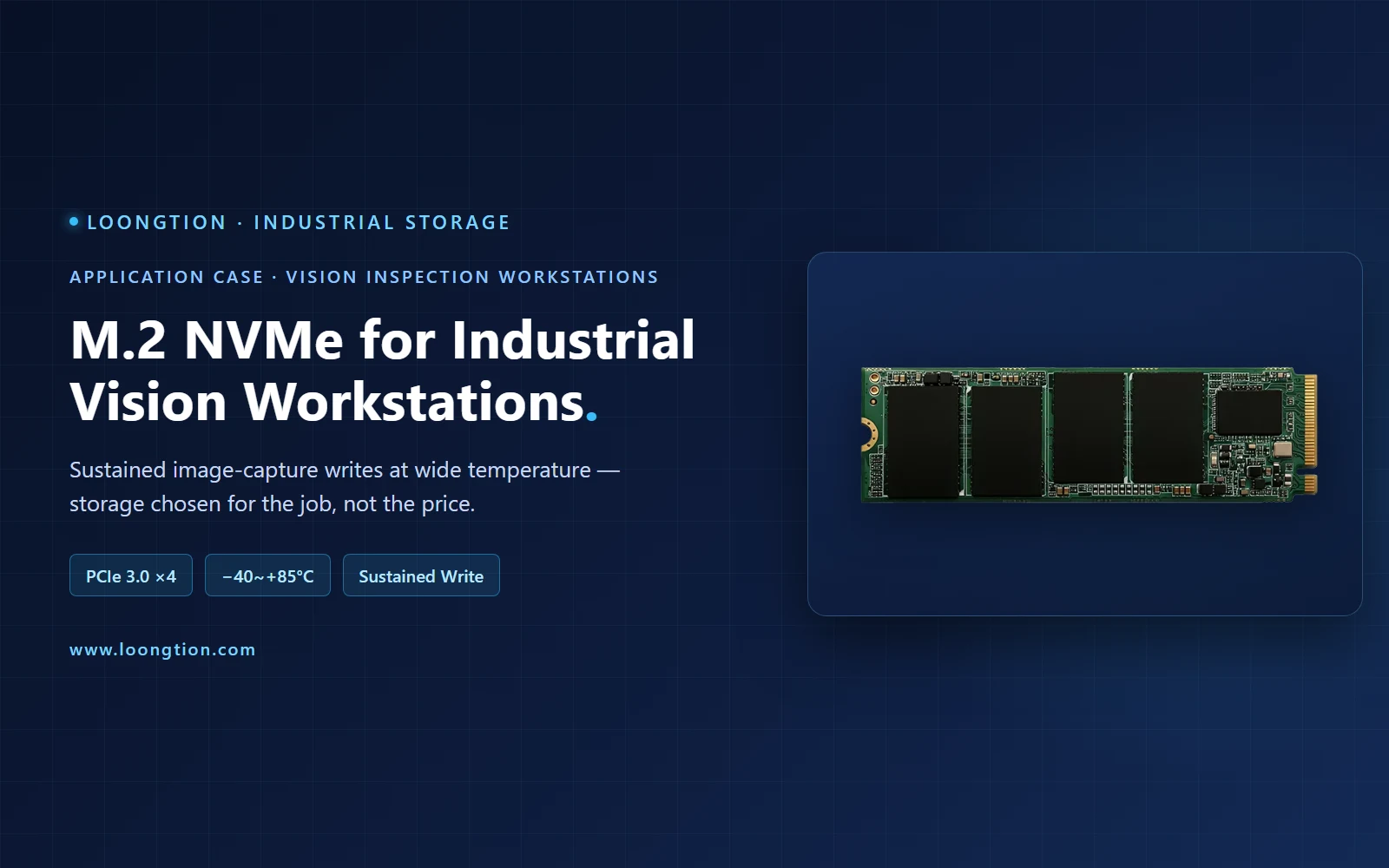
A vision inspection workstation needs storage that absorbs continuous high-resolution capture writes at workshop temperatures. Why M.2 NVMe, and how to spec it.
Scene
A vision inspection workstation on an electronics assembly line has one job: capture frames from high-resolution cameras as boards pass underneath, run defect detection, and keep the line moving. The cameras are relentless — several frames per second, all day, every shift — and every frame has to land somewhere before the next one arrives.
That "somewhere" is where this story starts. The workstation's main storage was a SATA SSD, and under continuous capture it became the bottleneck. When the write buffer filled faster than the drive could drain it, the capture pipeline stuttered, frames were dropped, and the detection software occasionally froze mid-batch. In summer, with the workshop running warm and the cabinet door closed, the problems got worse: consumer-grade drives, never designed for sustained writes in a hot enclosure, became unreliable.
The fix was not a faster camera or a bigger buffer. It was giving the workstation storage that could actually absorb the write load at the temperature the line operates at.
Why M.2 NVMe matters here
A vision workstation's storage plays two very different roles at once.
First, it is the system drive: the operating system, the vision software, and the neural-network models all load from it, which means low-latency random reads and quick boot times matter every shift. Second, it is the image buffer and short-term archive: every captured frame is written sequentially, continuously, at rates that a SATA interface simply cannot keep up with — SATA tops out at roughly 550 MB/s, while a PCIe 3.0 x4 link runs several times faster.
For sustained capture sessions, the architecture of the drive matters as much as the interface. An SSD with onboard DRAM cache keeps write performance steady when the buffer is under continuous pressure, rather than degrading once a small SLC cache is exhausted.
Then there is the environment. Workshops are not climate-controlled computer rooms. Cabinets sit in the sun, lines run around the clock, and the temperature inside an enclosure can swing far outside the 0–70°C range of commercial drives. For storage that must never drop a frame, an industrial temperature rating — typically −40°C to +85°C — is not a luxury, it is the specification.
Finally, endurance. Image capture is one of the heaviest write workloads in industrial computing. A workstation writing a few hundred gigabytes per shift accumulates petabytes over a few years. Drives are rated in TBW (total bytes written); choosing one whose endurance rating matches the actual workload is what keeps a line from failing in year three.
Selection notes
- Interface and form factor. M.2 2280 with an M-Key connector and PCIe 3.0 x4 lanes running the NVMe 1.4 protocol. Verify the industrial PC actually routes PCIe to its M.2 slot — some boards only bring SATA there.
- DRAM cache vs. cacheless. For sustained sequential writes, a DRAM-cached version holds performance steadier than a cacheless HMB design. Cacheless saves cost and power; cached wins on sustained write consistency.
- Temperature grade. Specify industrial grade (−40°C to +85°C operating) for anything inside a cabinet or on a production floor. Commercial grade is a false economy on a line that runs around the clock.
- Endurance. Match TBW to the workload: a 1 TB drive rated at 400 TBW covers roughly 1.1 TB written per day for a year — a reasonable starting point for a single-shift vision station; scale up for multi-shift or multi-camera setups.
- Power budget. NVMe drives draw more than SATA under sustained write — maximum sequential write power on larger capacities can reach several watts. Confirm the industrial PC's power supply and thermal design have headroom.
- Reliability features. Look for wear leveling, undervoltage and short-circuit protection, and a warranty that matches the equipment's service life.
A final note
None of this is exotic — it is the difference between storage chosen for price and storage chosen for the job. Industrial memory suppliers such as Loongtion exist to serve exactly these applications: M.2 NVMe SSDs specified for wide temperature, sustained writes, and a five-year service life, built for the lines that cannot stop.
Related products
Product lines commonly shortlisted for this application — open a page for PN, temperature grade, and datasheet request.
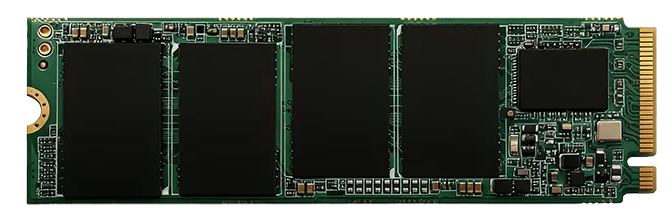
M.2 2280 NVMe SSD (Cacheless) · Wide-temp
- PCIe 3.0×4 Lanes
- Supports TRIM/NCQ/S.M.A.R.T
- Compatible with Industrial
M.2 2280 NVMe SSD (With Cache) · Wide-temp
- Independent DRAM cache
- PCIe 3.0×4 lane
- Compatible with Industrial