
DDR4 EOL and the Supply Window: Procurement Strategies for Industrial Memory
The DDR4 supply window is closing — and it will not reopen
In June 2025, Samsung stopped accepting new DDR4 orders. SK Hynix cut DDR4 production in step. Micron held to its original end-of-life plan. Across the major market researchers — TrendForce, Gartner, and IDC — the consensus is the same: DDR4 prices will not fall before the end of 2027.
For industrial design and procurement teams, this is not a routine component cycle. DDR4 is the memory inside PLCs, HMIs, substation and railway controllers, test equipment, medical devices, and thousands of other products with ten-year-plus service lives. The parts you qualified in 2020 are being discontinued while your product still has years of production ahead. The window to secure supply is open now — and it closes as remaining inventory is absorbed.
Why this contraction is permanent: the HBM gravity well
The usual mental model — "prices will recover when demand softens" — does not apply to DDR4 this time. The reason is high-bandwidth memory for AI accelerators. HBM consumes roughly 2.5–3x the wafer capacity per gigabyte that DDR4 does, and commands 5–8x the price. The three major DRAM manufacturers have structurally shifted capacity toward HBM and DDR5. DDR4 supply is therefore shrinking permanently, not dipping through a demand cycle that will come back.
Demand is not shrinking with it. The industrial and IoT DRAM market is projected to grow from $3.18 billion in 2025 to $6.32 billion by 2031, a 12.5% CAGR. Industrial systems live longer, keep legacy interfaces, and are only now being designed in larger numbers for automation, energy, and transport. The demand side of DDR4 keeps running while the supply side walks away.
This combination — permanent supply contraction against growing demand — is what makes the current situation different from every earlier DDR generation transition. DDR3 exits happened against a background of abundant DDR4 capacity. This time, the successor generation itself is capacity-constrained by AI memory demand.
What the price and lead-time data show
The numbers worth putting in front of management:
- DDR4 contract prices rose 30–50% quarter-over-quarter from mid-2025.
- An 8Gb DDR4 die that cost roughly $2.50 in early 2024 now trades at $4.00–5.50 — a 60–120% increase in 18 months.
- For the first time in industry history, the legacy generation costs more than the current one.
- Industrial-grade lead times stretch to 20–26 weeks (commercial grade 14–18); RDIMMs run 16–22 weeks; LPDDR4 is effectively out of stock.
A 20–26 week lead time means a single component can stall a production line for half a year. For a product shipping a few hundred units a quarter, that is one or two quarters of deliveries lost — plus the expedite premiums, the air-freight surcharges, and the engineering hours spent re-qualifying alternatives under deadline pressure. The supplier that quotes 4–8 weeks is not a convenience; it is the difference between shipping and waiting.
Part-number reality: what is already happening at the model level
The clearest example is Samsung's K4A8G085WC — an 8Gb DDR4 deployed across a very wide range of industrial boards. It has moved to NRND (not recommended for new designs). The remaining production is locked to NCNR (non-cancellable, non-returnable) contract customers in the server business, and smaller industrial buyers effectively lose access to spot channels. The x16 sibling K4A8G165WC, widely used in compact embedded controllers, is under the same pressure.
What NRND means operationally is worth spelling out. The part can still be ordered for a limited window, but distributors stop replenishing, your regular channel quietly stops holding stock, and the last-time-buy deadline becomes a hard date on the calendar. If your BOM contains either part, you are already on borrowed time. If it contains similar DDR4 from Micron, SK Hynix, or other suppliers, check EOL status this quarter — not when the shortage notice arrives.
Four paths when the EOL notice arrives
| Path | What it means | Main risk |
|---|---|---|
| Last-time buy (LTB) | Order lifetime stock at the final call | Cash tied up, forecast risk, no second chance |
| Spot market | Buy from distributors and stockists | Drying up, price spikes, counterfeit risk |
| Pin-to-pin replacement | Source a drop-in compatible part | Requires qualification of package, temperature, speed |
| Redesign to DDR5 | New layout, new qualification | Long cycle and requalification cost |
Most teams try LTB first, then discover the spot market has already priced in the scarcity. LTB commits cash against a forecast that is almost never accurate, and DRAM inventory cannot be returned if the product forecast slips. The spot market is where the price inversion bites hardest, and as scarcity deepens, counterfeit and re-marked parts become a real risk in the grey channel.
The pragmatic middle path — a pin-to-pin replacement from a supplier that maintains the part — is often the fastest way to keep the line running while the redesign decision is made calmly rather than under a deadline. A PCB respin plus controller requalification spans quarters, not weeks; a verified pin-to-pin substitute can be qualified and ramped in the time it takes to schedule the redesign work.
What a pin-to-pin replacement has to prove
Not every "compatible" part is actually compatible. Before approving a substitute, verify five things against your controller and board:
- Package and ball map. DDR4 comes in x8 (FBGA78) and x16 (FBGA96) flavors. The ball maps are different and not interchangeable — an x8 part cannot fill an x16 socket, and a layout built for one will not work with the other.
- Temperature grade. Industrial equipment needs −40°C to +85°C or wider. Some 8Gb DDR4 offerings are rated only 0°C to +95°C and fail cold-start qualification, whatever the price advantage.
- Speed grade at temperature. A replacement that only reaches 2666 MT/s at wide temperature forces the controller down from DDR4-3200. Verify the speed grade is maintained at the temperature you actually operate at — a part that is fast at +25°C but drops at +85°C will cause intermittent failures in the field.
- Voltage and controller configuration. DDR4 runs at 1.2V ±0.06V, but confirm the replacement matches your controller's configuration registers and training flow before committing.
- Ordering form and packaging. Tray and tape-and-reel variants are electrically identical but must match your assembly line's feeding format — a detail that has stopped many quick qualification swaps.
What procurement should do now
- Inventory your active BOMs for DDR4 parts and check EOL/NRND status this quarter.
- Request a cross-reference evaluation early — qualification is far easier while the original part is still orderable and boards are still available for testing.
- Verify the three silent killers: package (x8/x16), temperature grade, and speed grade at temperature.
- Lock in a second source with a committed lead time. In today's market, 4–8 weeks beats 20–26, and a committed lead time is worth more than a lower unit price.
- Plan the DDR5 migration at your own pace — from a position of supply security, not panic. The multi-generational BOM strategies guide is a useful starting framework for sequencing the transition across your product family.
Where to start on Loongtion
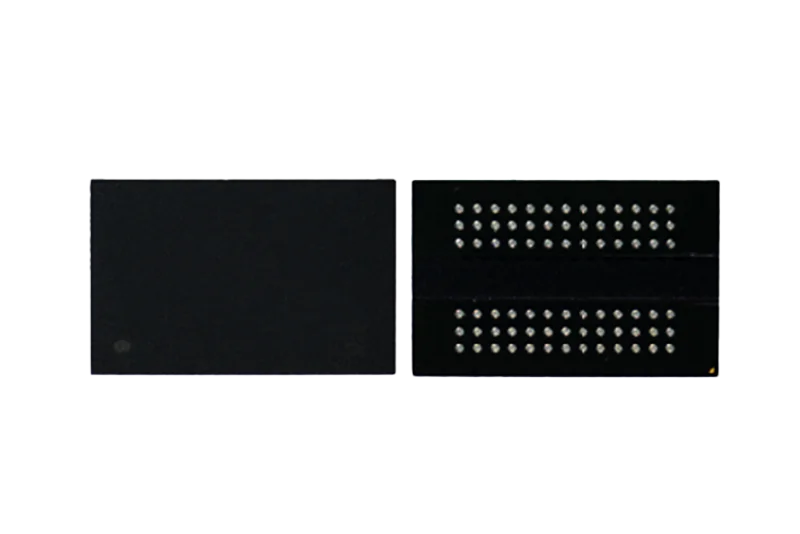
Loongtion's DDR4 line is built for exactly this window: 8Gb DDR4 at −40°C to +85°C, full DDR4-3200 speed, in both FBGA78 (x8) and FBGA96 (x16) packages, with pin-to-pin cross-references for Samsung and Micron parts. For example, the K4A8G165WC maps to the YZ48G16V with the same footprint and full 3200 MT/s at wide temperature. Lead times are 4–8 weeks with a one-piece MOQ, and the parts carry a five-year supply commitment.
Start with the K4A8G165WC cross-reference guide or the industrial DDR4 selection guide, review the DDR4 product line, or contact Loongtion with your BOM for a cross-reference evaluation.
Related products
Shortlist lines referenced in this guide — open the product page for PN, grades, and datasheet request.
Related resources
Continue with related selection guides and notes for the same industrial memory topic.
Related cross-references
Pin-to-pin and functional alternatives referenced from this guide — for BOM review, dual-sourcing, or EOL coverage.