
eMMC vs NVMe BGA SSD: A Practical Guide for Industrial Embedded Storage Decisions
Say you are putting together an embedded system — an industrial controller, an IoT gateway, maybe a ruggedized computer. Processor picked, peripherals mapped, and now you hit the storage decision: eMMC or NVMe BGA SSD? Both are BGA packages that solder onto the board. Both pack a controller and NAND flash in one package. They are not interchangeable though, and picking the wrong one means either leaving performance on the table or burning budget you did not have to burn.
We will walk through the architectural differences, the performance and endurance trade-offs, the temperature grades available, and the actual application scenarios where one choice clearly wins. The examples come from Loongtion's product line because specs in a datasheet hit differently when you can map them to a real part number you can order.
What an eMMC Actually Is
eMMC started as a soldered-down MMC card. JEDEC standardized it into its own spec, now at version 5.1. The package is a NAND flash array plus a microcontroller that handles all the flash management: bad block mapping, ECC, wear leveling, garbage collection. The host never talks to the raw NAND. You send standardized commands over an 8-bit parallel bus — CMD, CLK, DAT0-7, DS — and the eMMC controller does the rest.
The interface is not complicated. You initialize it with CMD0, CMD1, CMD2, assign a relative card address, and you are in data transfer mode. The bus supports SDR and DDR modes with clock speeds up to 200 MHz in HS400 mode. That gives a theoretical 400 MB/s peak on the 8-bit bus. Real sustained sequential reads land around 150-300 MB/s, depending on NAND type and controller efficiency.
The eMMC controller is lightweight. Small SRAM buffer, no DRAM cache. Command queuing is limited compared to NVMe. The design goal is "good enough for the target workload" rather than "push the interface to its limits." That keeps BOM cost low and power draw minimal. In sleep mode an eMMC can drop to near-zero current.
The downside is the parallel interface. At 200 MHz, routing 8 data lines plus a strobe on a PCB takes care with signal integrity, especially across temperature. And firmware updates need a full reflash of the eMMC boot partition, which creates a failure point in the field that is hard to recover from without a physical programmer.
What an NVMe BGA SSD Is and Why It Is Different
An NVMe BGA SSD looks similar from the outside — BGA package, NAND plus controller inside. But the interface, the controller, and the performance curve are a different animal entirely.
Instead of a parallel bus, you get a PCI Express serial interface. The Loongtion NVMe BGA SSD runs PCIe Gen3 with up to four lanes. Each lane is a serial differential pair at 8 GT/s. Four lanes give a theoretical 4 GB/s each direction. Real-world numbers depend on flash and controller, but the Loongtion pSLC models do 1,200 MB/s sequential reads and 1,300 MB/s sequential writes. About 4x to 8x faster than eMMC on sequential workloads.
The controller is a different class. Loongtion's YIDF series runs a full NVMe 1.4 protocol stack with command queuing, multiple I/O queues, interrupt coalescing, and Host Memory Buffer. HMB borrows a small chunk of host DRAM for mapping tables, so the drive works without a local DRAM cache and still delivers solid random IOPS. The pSLC parts hit 120K random write IOPS.
The power draw reflects the difference. An NVMe BGA SSD in pSLC mode draws about 2.1 to 3.1 W during writes. An equivalent eMMC draws roughly 0.4 W. If your system is power-constrained, eMMC wins on thermal budget alone.
Package size is 20 mm × 16 mm × 1.3 mm for the Loongtion NVMe BGA SSD, larger than a typical eMMC (11.5 mm × 13 mm × 1.0 mm). The real trade-off is PCB complexity: PCIe means differential pair routing with controlled impedance.
Head-to-Head Comparison
| Parameter | eMMC 5.1 (Loongtion YIDL series) | NVMe BGA SSD (Loongtion YIDF series) |
|---|---|---|
| Interface | 8-bit parallel (HS400) | PCIe Gen3 x2/x4 |
| Peak Bandwidth | 400 MB/s (theoretical) | 4 GB/s (theoretical, PCIe 3.0 x4) |
| Sequential Read | ~150-300 MB/s (typical) | 1,100-1,200 MB/s (TLC/pSLC) |
| Sequential Write | ~130 MB/s (HS400) | 550-1,300 MB/s (TLC/pSLC) |
| 4KB Random Read | 5K-10K IOPS (typical) | 15K-20K IOPS |
| 4KB Random Write | 3K-5K IOPS (typical) | 120K IOPS |
| Command Queuing | Limited (eMMC CQ) | Full NVMe multi-queue |
| DRAM Cache | None (SRAM buffer only) | None (HMB-based) |
| pSLC Endurance (128GB) | Not published as TBW | 600 TBW |
| Temp Range (Industrial) | -40°C to +85°C | -40°C to +85°C |
| Temp Range (Extreme) | -55°C to +95°C (GJB-STD screened to +105°C) | -55°C to +105°C (pSLC, GJB-STD) |
| Package | 11.5×13×1.0 mm, 153 FBGA | 20×16×1.3 mm, 291 FBGA |
| PCB Routing | Simple (single-ended traces) | Complex (differential pairs, impedance control) |
| Relative Cost | Lower | Higher |
eMMC wins on simplicity, size, and cost. NVMe BGA wins on throughput, random IO, and command efficiency.
Application Scenarios
When eMMC Makes Sense
Industrial IoT gateways and PLCs. These log sensor data, run Modbus or OPC-UA stacks, and push firmware updates once in a while. The workload is moderate sequential writes with occasional reads. The Loongtion YIDL032MNT-S (32 GB TLC, -40°C to +85°C) fits here without over-engineering.
Telecom base station control boards. Base stations stay in the field for a decade or more. Storage demand is modest, and the interface needs to stay simple across hardware revisions.
Medical monitoring peripherals. Compact, low-power, no need for PCIe routing complexity. eMMC in sleep mode draws almost nothing.
When NVMe BGA SSD Wins
Edge AI inference nodes. These pull model weights and input data from storage, process video streams or sensor fusion data locally. 1,200 MB/s sequential reads translate to real loading time gains. The Loongtion YIDF128NMS-S (128 GB pSLC, -40°C to +85°C) handles this.
Ruggedized mission computers in vehicles and aircraft. Vibration, temperature swings, high write loads. PCIe bandwidth and pSLC endurance (300 TBW for 64 GB pSLC) matter here. Loongtion Extreme-grade NVMe BGA parts carry GJB-STD validation including 20,000G shock testing.
Boot drives for embedded servers and network appliances. NVMe multi-queue architecture means multiple network processing threads can submit I/O without serializing on a single command pipeline.
Loongtion Product Options for Both Paths
eMMC (pSLC, Extreme temp -55°C to +95°C, GJB-STD screened to +105°C): YMDL008MNS-S (8 GB), YMDL016MNS-S (16 GB), YMDL032MNS-S (32 GB), YMDL064MNS-S (64 GB)
eMMC (TLC, Wide temp -40°C to +85°C): YIDL032MNT-S (32 GB), YIDL064MNT-S (64 GB), YIDL128MNT-S (128 GB), YIDL256MNT-S (256 GB)
NVMe BGA SSD (pSLC, Industrial -40°C to +85°C): YIDF032NMS-S (32 GB), YIDF064NMS-S (64 GB), YIDF128NMS-S (128 GB)
NVMe BGA SSD (TLC, Industrial -40°C to +85°C): YIDF256NMS-S (256 GB, PCIe 3.0 x4), YIDF512NMS-S (512 GB, PCIe 3.0 x4)
NVMe BGA SSD (pSLC, Extreme -55°C to +105°C): YMDF064NMS-S (64 GB, screened, GJB-STD), YMDF128NMS-S (128 GB, screened, GJB-STD)
Making the Call
If your workload is sequential writes on a single-threaded control app, start with eMMC. Lower cost, simpler PCB, easier qualification. If your application runs multiple concurrent threads, loads large models, or logs high-bandwidth sensor data, NVMe BGA is worth the extra development cost. The gap is not a few percent. It is several multiples.
Both are embedded storage from the same manufacturer with the same quality system and temperature grading. The interface divides them, and the interface decision drives the rest.
Need help mapping a specific Micron, Samsung, or Swissbit eMMC or BGA SSD to a Loongtion equivalent? Check the cross-reference page or contact the engineering team directly.
For the full product portfolio including DRAM, NAND Flash, and SSDs in other form factors, visit the products page.
Related products
Shortlist lines referenced in this guide — open the product page for PN, grades, and datasheet request.
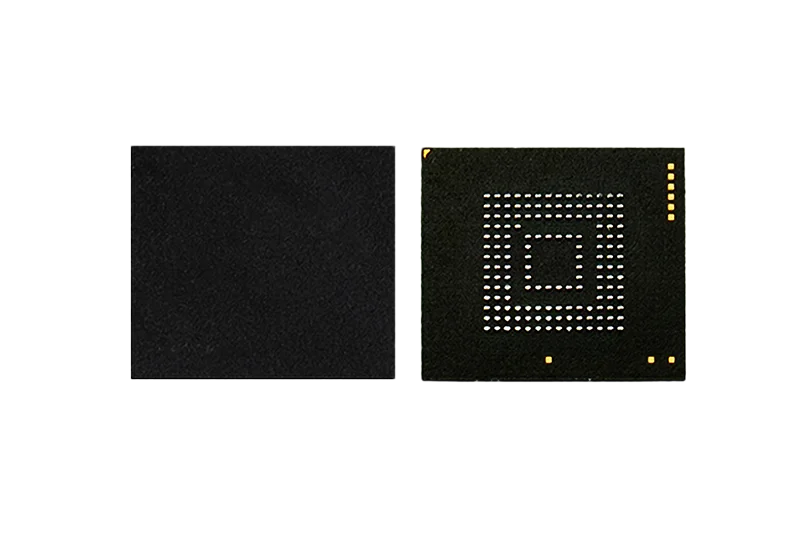
eMMC Storage Chip
- NAND Flash and controller
- Complies with the eMMC 5.1
- Operates over a wide
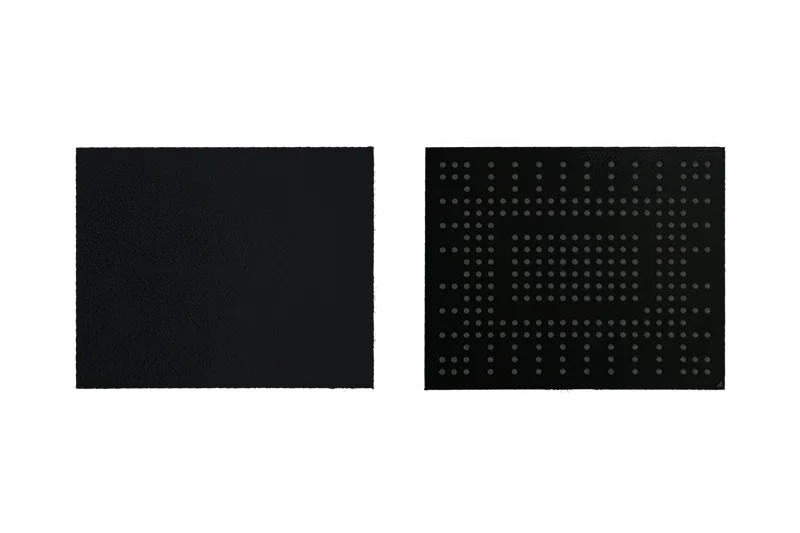
NVMe BGA SSD · Wide-temp
- FBGA291 Package
- PCIe Gen3×4 Interface
- Environmental testing
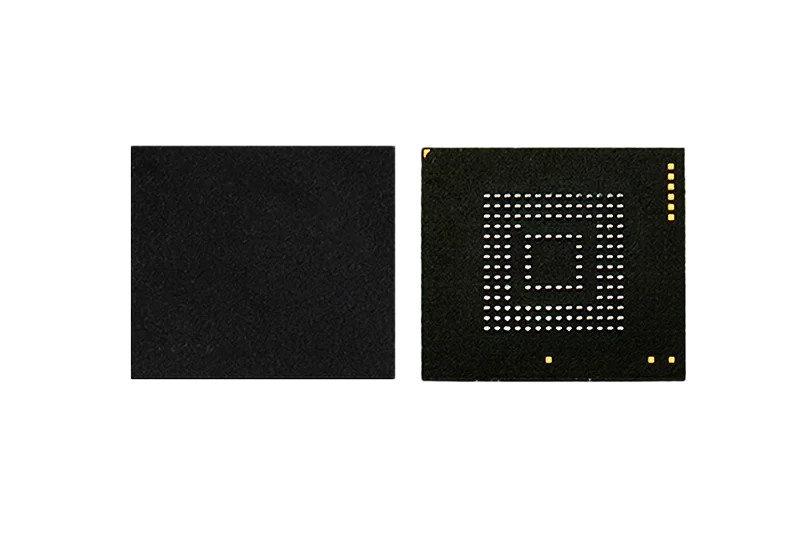
eMMC pSLC
- Encapsulates NAND flash
- Complies with the eMMC 5.1
- Clock speed up to 400MHz
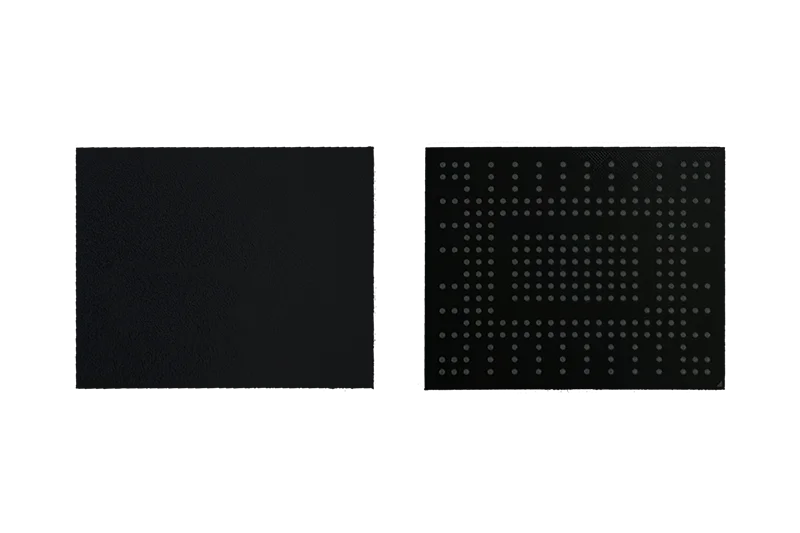
NVMe BGA SSD · Extreme
- Adopts PCIe Gen3×4 interface
- Compared with traditional
- Supports multiple systems
Related resources
Continue with related selection guides and notes for the same industrial memory topic.
Related cross-references
Pin-to-pin and functional alternatives referenced from this guide — for BOM review, dual-sourcing, or EOL coverage.