
ISSI IS43TR16256BL / Winbond W632GU6KB Replacement: Loongtion DDR3 Cross-Reference Guide
The DDR3 sourcing problem nobody talks about
Here's the situation a lot of industrial BOM owners are walking into in 2026. Their DDR3 supply is locked to one vendor, ISSI, Winbond, or a legacy Micron part, and that vendor is either winding down the line, or the price has crept up to the point where finance is asking questions. DDR3 refuses to die. Ten-year-old designs still ship, and the JEDEC standard parts are still produced. But the industrial temperature versions are the ones getting hard to find.
ISSI's IS43TR16256BL and Winbond's W632GU6KB are both real workhorses in this space. If you're running either of them, you don't need a lecture on why DDR3 is still relevant. You need to know whether a second source exists that matches the footprint, the voltage, and the temperature grade — without a board redesign.
That's what this guide covers.
What actually matters when cross-referencing DDR3
Before the table, a quick note on what "compatible" means in practice. Three things decide whether a swap works:
- Footprint. DDR3 chips in ×16 configuration use the FBGA96 package. If the new part is also FBGA96, the mechanical swap is trivial.
- Voltage rail. 1.5V-only parts are a problem for 1.35V designs. Dual-voltage parts (1.35V/1.5V) drop into both.
- Temperature grade. This is where most "compatible" claims fall apart. A commercial 0°C~+70°C part is not a replacement for an industrial -40°C part, regardless of what the pin-out looks like.
Parameter comparison: ISSI IS43TR16256BL vs Winbond W632GU6KB vs Loongtion
| Spec | Loongtion YZ38E16SBB-9MFB-M | ISSI IS43TR16256BL-125KBLI | Winbond W632GU6KB |
|---|---|---|---|
| Interface | DDR3 (SSTL) | DDR3 (SSTL) | DDR3 (SSTL) |
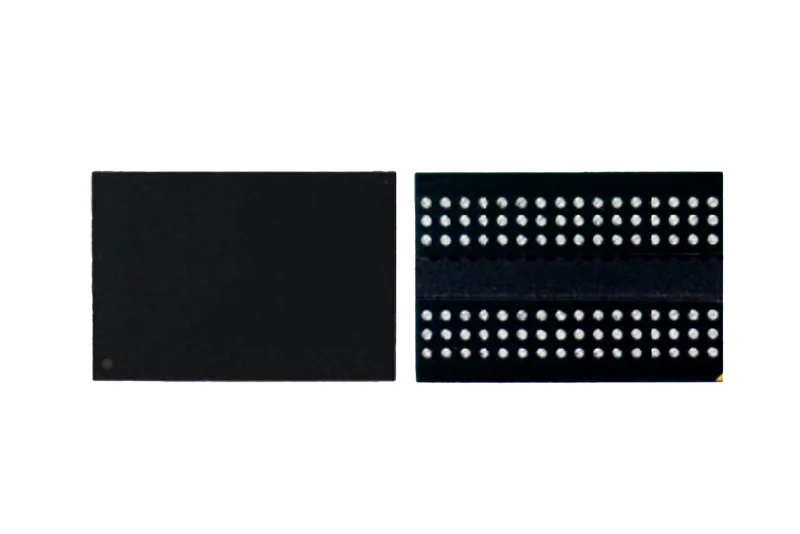
| Package | FBGA96 | FBGA96 | FBGA96 |
| Density | 2Gb (128M×16) | 4Gb (256M×16) | 2/4Gb |
| Temperature | −55°C ~ +105°C (GJB-STD) | -40°C ~ +95°C | -40°C ~ +85°C |
| Data rate | 800/933 MHz | 1600 Mbps (DDR3-1600) | 1866 Mbps |
| Voltage | 1.35V/1.5V dual | 1.5V | 1.35V/1.5V |
| Grade | GJB 9001C qualified | Industrial | Industrial |
| Cross-ref type | Pin-to-pin (MT41K128M16JT) | Functional alternative | Functional alternative |
Read that temperature row twice. The Loongtion part is rated at -55°C on the low end, a full 15°C below the ISSI and Winbond industrial ratings. On the high end, the storage temperature rating goes to +125°C under GJB-STD. The ISSI part tops out at +95°C, the Winbond at +85°C for operating range.
That gap matters in specific places: arctic telecom cabinets, UAV avionics, military vehicle electronics, oil and gas exploration gear in Siberia or Alaska. If your system has ever had a cold-start failure below -40°C, you know exactly what this row means.
Loongtion part numbers for your BOM
Depending on the density and grade you need, here's the mapping:
| Loongtion PN | Density | Grade | Cross-references |
|---|---|---|---|
| YZ38E16SBB-9MFB-M | 2Gb | GJB-STD, -55°C~+125°C | MT41K128M16JT-125IT:K |
| YZ38E16SBB-9MFB-M(O) | 2Gb | Wide-temp, -40°C~+85°C | ISSI / Winbond 2Gb |
| YZ38F16SBB-9MFD-M | 4Gb | GJB-STD, -55°C~+125°C | MT41K256M16HA-125IT |
| YZ38F16SBB-9MFD-M(O) | 4Gb | Wide-temp, -40°C~+85°C | IS43TR16256BL 4Gb |
| YZ38G16SDB-9INN-M(0) | 8Gb | Industrial, 0°C~+85°C | — |
So if your design runs the ISSI 4Gb part, the YZ38F16SBB-9MFD-M(O) is the direct wide-temp counterpart. If you're on the Winbond 2Gb, the YZ38E16SBB-9MFB-M(O) maps across.
Where ISSI and Winbond still win
Honesty check, because a pure "buy ours" pitch would be useless to you. ISSI and Winbond are established names with decade-long field history, broad distribution, and parts that are proven in millions of shipped units. If your BOM is already qualified on one of them and your volumes are healthy, there's a legitimate argument for staying put. Dual-sourcing is a hedge, not a mandate.
Where Loongtion closes the gap:
- Temperature floor. Nobody in this comparison goes below -40°C except Loongtion. If your spec sheet says -55°C, this is not a nice-to-have.
- GJB 9001C qualification. The military-grade validation regime covers temperature cycling from -55°C to +105°C, mechanical shock to 20,000G, and lot traceability beyond JEDEC industrial specs.
- Voltage flexibility. The 1.35V/1.5V dual-rail support means one part number covers both DDR3L and DDR3 designs. ISSI's 4Gb part here is 1.5V-only.
- Domestic production. If supply-chain diversification away from US/KR/JP concentration is on your risk register, a Chinese-qualified source changes the calculus.
One thing to verify before you swap
Don't take the table as gospel for your specific board. The electrical specs match at the JEDEC level, but you should confirm three things against your schematic before a pilot run:
- Thermal profile — is your worst-case ambient below -40°C? Then only the GJB part qualifies.
- Data rate — the Loongtion YZ38E16SBB-9MFB-M is spec'd at 800/933 MHz. Check your controller's data-rate requirement before you swap; the ISSI part runs 1600 Mbps and the Winbond 1866 Mbps, so verify the timing budget against your design.
- Density — the 2Gb part is 128M×16. If your design needs 256M×16 (4Gb), pick the YZ38F16SBB-9MFD-M(O) instead.
If you want, send your schematic or BOM over and we'll do the sanity check with you. That's a normal engineering conversation, not a sales call.
Summary
| Vendor part | Loongtion counterpart | Best-fit scenario |
|---|---|---|
| ISSI IS43TR16256BL-125KBLI | YZ38F16SBB-9MFD-M(O) | 4Gb wide-temp, -40°C~+85°C |
| Winbond W632GU6KB | YZ38E16SBB-9MFB-M(O) | 2Gb wide-temp, -40°C~+85°C |
| Any 2Gb DDR3 | YZ38E16SBB-9MFB-M | Extreme -55°C~+105°C, GJB |
Related guides: Micron MT41K128M16JT replacement · Samsung K4B4G1646 DDR3 · DDR3 product line
Need a second source for your DDR3 BOM? Talk to our engineering team →
Related products
Shortlist lines referenced in this guide — open the product page for PN, grades, and datasheet request.
Related resources
Continue with related selection guides and notes for the same industrial memory topic.
Related cross-references
Pin-to-pin and functional alternatives referenced from this guide — for BOM review, dual-sourcing, or EOL coverage.