
42mm M.2 2242 SATA SSD: The Unlikely Hero of 85°C Industrial Environments
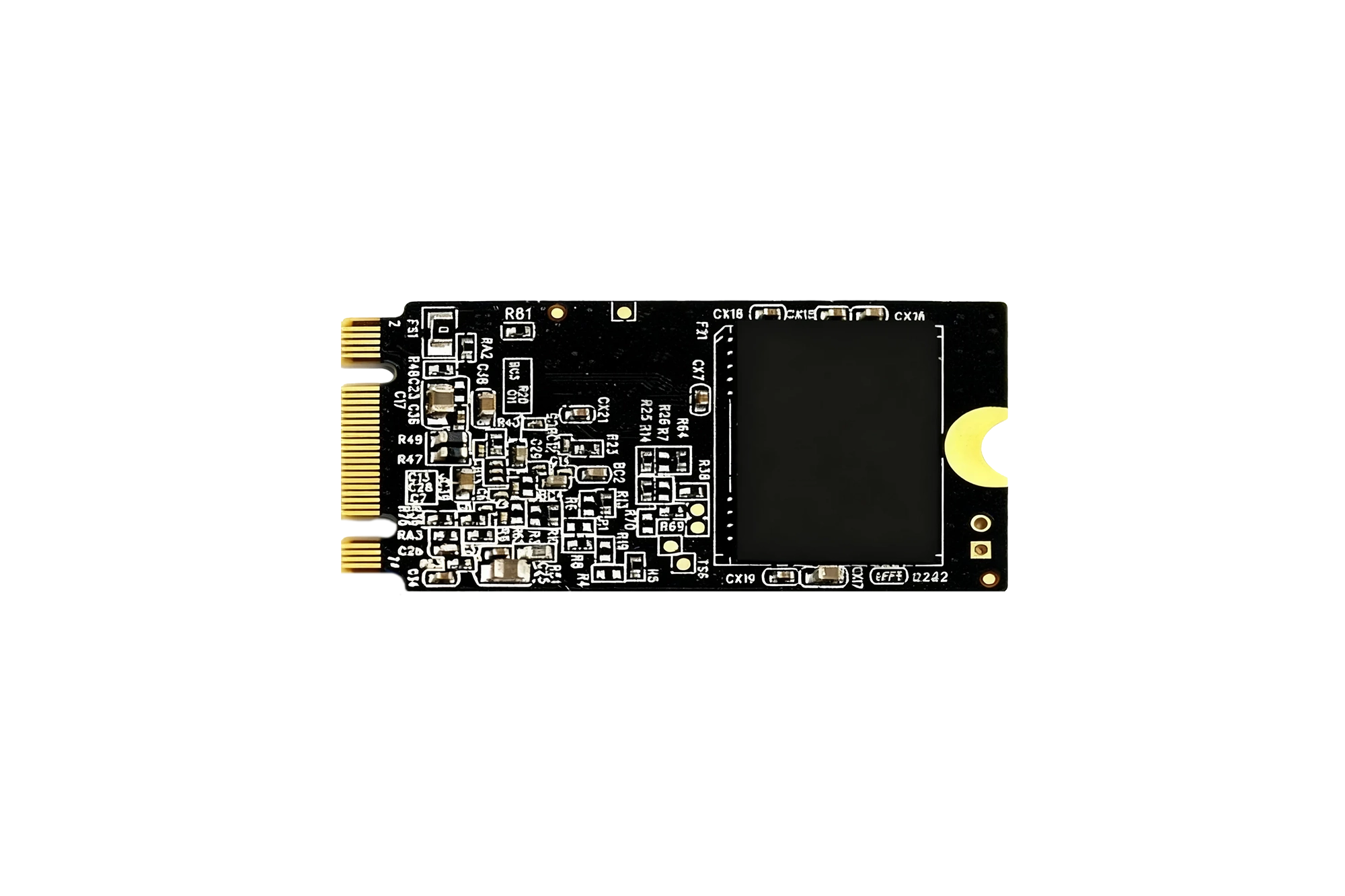
In a market dominated by high-speed NVMe drives, the 42mm M.2 2242 SATA SSD remains a critical component in industrial environments. It is not designed for benchmark scores, but for deterministic reliability across a -40°C to +85°C temperature range. This article examines the engineering choices behind this niche product: full-temperature-range NAND flash screening,
Introduction: A Market Paradox
In the consumer storage market, specifications like PCIe Gen 4 and read speeds exceeding 7,000 MB/s dominate the conversation. The M.2 2242 SATA solid-state drive, with its 42mm length and legacy interface, is largely absent from retail shelves. It is a product that appears obsolete by every modern consumer metric.
Yet, inside industrial automation controllers, outdoor base stations, and in-vehicle data terminals, this same drive is the standard. It operates continuously in environments ranging from -40°C to +85°C, under constant vibration and unstable power. This paradox highlights a fundamental divergence in design philosophy.
Core Thesis: Divergent Design Objectives
A consumer SSD is designed to deliver maximum performance at minimum cost within a benign environment of 0°C to 70°C and stable power. Benchmark scores and user experience are the primary metrics.
An industrial M.2 2242 SATA SSD is engineered for a different objective function entirely: to guarantee data integrity and operational determinism in a space-constrained format under extreme thermal, mechanical, and electrical stress. Performance is secondary to reliability and predictability. This fundamental difference cascades through every layer of the design, from component selection to firmware.
Dimension 1: NAND Flash Physics and the Challenge of Wide Temperatures
The NAND flash memory cell is highly sensitive to temperature, presenting a primary physical challenge for industrial storage.
The High-Temperature Problem: At 85°C, the charge stored in the floating gate leaks at an exponentially higher rate, governed by the Arrhenius equation. This significantly reduces data retention and can increase the raw Bit Error Rate (BER) from 10⁻¹⁵ at room temperature to 10⁻¹², threatening data integrity.
The Low-Temperature Problem: At -40°C, the efficiency of the Fowler-Nordheim tunneling effect is drastically reduced. This slows down the programming operation, causing latency to increase from microseconds to milliseconds. Without firmware compensation, the system may time out, leading to a device failure.
Engineering Countermeasures
-
Full-Temperature NAND Screening: Each NAND die is tested at the -40°C and +85°C limits. Only dies that meet timing and error rate specifications are selected. The target is an Uncorrectable Bit Error Rate (UBER) of less than 10⁻¹⁶.
-
LDPC Error Correction: Low-Density Parity-Check (LDPC) codes provide 3-5x stronger error correction than legacy BCH codes at high BERs, effectively recovering data lost to charge leakage.
-
Temperature-Compensated Read (TCR): An on-die temperature sensor provides real-time data. The firmware adjusts the read reference voltage dynamically to compensate for threshold voltage shifts caused by temperature changes.
Dimension 2: Circuit-Level Protection in a Confined Space
The M.2 2242 PCB has an area of approximately 924 mm², less than one-seventh that of a standard 2.5-inch drive. Despite this constraint, industrial-grade drives integrate a full Power-Loss Protection (PLP) circuit.
The PLP Circuit Workflow: A voltage monitor detects the input falling below a preset threshold and triggers a hardware interrupt. The firmware immediately halts all new I/O commands. Energy stored in onboard capacitors provides power for a critical 12ms window. During this time, any data in the DRAM buffer and the Flash Translation Layer (FTL) map are written to the non-volatile NAND.
The Critical Component: Capacitor Selection. The ability of the PLP circuit to function at low temperatures depends on the capacitors. Consumer-grade X5R MLCCs can lose over 40% of their capacitance at -40°C. Industrial drives use X7R or C0G grade capacitors, which retain over 85% of their capacitance at the same temperature.
Other circuit-level details include gold-plated SATA connectors (≥3μm thickness) to resist oxidation and a PCB with a high glass-transition temperature (Tg), such as FR-4 Tg170, to prevent warping at high temperatures.
Dimension 3: Firmware Algorithms for Longevity and Deterministic Performance
In a DRAMless architecture, the firmware is the key to extending NAND life and delivering consistent performance.
Wear Leveling: A Two-Tiered Strategy. Dynamic wear leveling selects the physical block with the lowest erase count for every new write. Static wear leveling is a background task that migrates "cold" data from blocks with low erase counts to blocks with higher counts. This ensures all blocks age uniformly, preventing premature failure of any single block.
Proactive Garbage Collection (GC). Consumer SSDs often use an SLC write cache to boost short-term performance, which can lead to a severe performance drop when the cache is exhausted and background GC is triggered. Industrial firmware uses a proactive GC strategy. It consolidates valid data and reclaims free space during idle periods, maintaining a pool of ready blocks. This prevents performance cliffs and ensures predictable latency under sustained write loads.
Dimension 4: Verification Beyond Consumer Standards
Every industrial-grade M.2 2242 SATA SSD must pass a rigorous series of environmental stress screening (ESS) tests to eliminate early-life failures.
- Thermal Cycling: 100 rapid cycles between -40°C and +85°C at 15°C/minute.
- Random Vibration: 5-2000 Hz at 20G for 30 minutes per axis.
- Mechanical Shock: Half-sine pulse, 1500G peak acceleration, 0.5ms duration.
- Damp Heat: 85°C / 85% relative humidity for 1000 hours.
Typical reliability metrics after such testing include an MTBF of 2 million hours (per Telcordia SR-332) and an UBER of less than 10⁻¹⁶.
Action Guide: When to Choose an Industrial M.2 2242 SATA SSD
Consumer-grade SSDs are not suitable when your application meets any of the following criteria:
- The system has a 42mm M.2 slot with a SATA interface.
- The ambient temperature will fall below 0°C or exceed 70°C.
- The system lacks a UPS and is exposed to power loss.
- The workload involves sustained, high-frequency writes.
- The system has a design life of more than 5 years where maintenance is costly.
Conclusion: Value Beyond Specifications
The value of an industrial M.2 2242 SATA SSD is not in raw performance. It lies in the system-level engineering that ensures deterministic reliability in extreme conditions. From component screening to firmware algorithms, each choice is made to service a single goal: guaranteeing data integrity in critical, unseen applications. Loongtion applies this full-stack reliability engineering to this niche form factor, ensuring consistent performance where consumer drives cannot operate.