
Industrial vs. Consumer 2.5-inch SSDs: Why the Price Gap? Four Core Differences That Determine Reliability
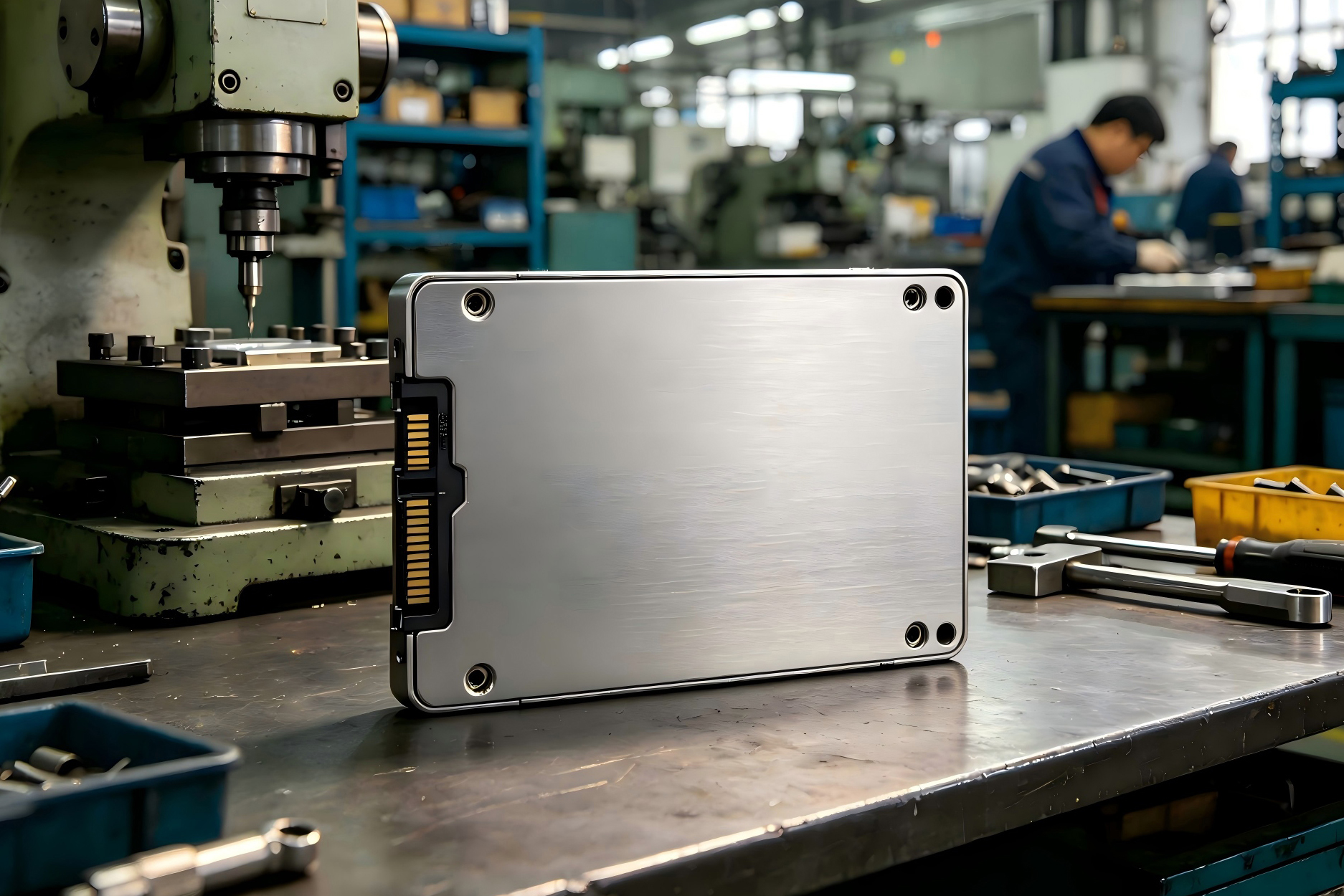
While they share the same physical interface and form factor, industrial-grade wide-temperature 2.5-inch SSDs and consumer SSDs are fundamentally different products. This article systematically examines the four key technical dimensions that separate them.
A common misconception in storage procurement is that all 2.5-inch SATA SSDs with the same capacity are interchangeable. The logic seems straightforward: same interface, same form factor, same function. Yet when a consumer-grade SSD is deployed in an outdoor base station, an industrial automation controller, or a vehicle-mounted system, failures often follow—drive dropouts, data corruption, or complete device failure. Meanwhile, an industrial-grade wide-temperature SSD operates reliably in the same harsh environment for years.
This performance gap is not a matter of brand premium. It represents a fundamental divergence in design philosophy, component selection, firmware architecture, and validation standards. Industrial-grade wide-temperature SSDs are engineered for one primary mission: to ensure data integrity and operational continuity where consumer SSDs are guaranteed to fail.
Core Conclusion: Survival Priority vs. Performance Priority
The essential difference between industrial-grade wide-temperature 2.5-inch SSDs and consumer SSDs stems from opposing design objectives.
Consumer SSDs are designed for controlled indoor environments (0°C to 70°C) with stable power. Their goal is to deliver competitive peak read/write performance at the lowest cost, serving intermittent workloads like gaming, office applications, and personal computing. Their expected service life is typically 3-5 years.
Industrial-grade wide-temperature SSDs are designed for uncontrolled extreme environments (-40°C to +85°C), continuous vibration, and unstable power conditions. Their goal is to guarantee data integrity, long-term device survival, and consistent performance under 7×24 continuous high-write workloads. Their service life must match industrial equipment lifecycles of 5-10 years or more.
This fundamental objective difference manifests across four distinct technical dimensions, forming an insurmountable reliability barrier.
Dimension One: Physical Layer Survival—Wide-Temperature Tolerance
Temperature is the primary factor affecting NAND flash behavior and controller stability. This dimension reveals the most tangible difference between the two product classes.
Operating Temperature Range
Consumer SSDs operate within 0°C to 70°C, assuming climate-controlled environments. Industrial scenarios present extreme variability: outdoor winter temperatures in northern regions can drop below -40°C, while sealed enclosures in summer can exceed 85°C. Vehicle engine compartments add further thermal stress.
At low temperatures, standard NAND flash exhibits dramatically slower charge capture and release, causing write latency to spike from milliseconds to seconds or result in timeouts. At high temperatures, charge loss accelerates exponentially, reducing data retention time and increasing error rates.
Component-Level Design
Achieving wide-temperature operation requires more than flash binning. Industrial SSDs employ:
- Capacitors: Standard electrolytic capacitors lose most of their capacitance at -40°C, rendering them unable to provide backup power for data protection circuits. Industrial SSDs use solid-state or tantalum capacitors rated for the full temperature range.
- PCB Materials: High glass-transition temperature (Tg) substrates resist physical deformation under thermal cycling.
- Connectors: Gold-plated SATA connectors with 3μ or thicker plating resist oxidation and maintain electrical contact integrity through repeated thermal expansion and contraction.
Flash Die Selection
Industrial SSDs subject NAND flash dies to rigorous boundary testing and screening. Only dies that maintain acceptable read/write timing, error rates, and data retention across the full specified temperature range are selected for use.
Dimension Two: Controller Layer Intelligence—Firmware and Endurance Management
Firmware is the brain of an SSD, determining its behavior under all conditions. Given the same TLC or MLC NAND, consumer and industrial firmware employ fundamentally different scheduling strategies.
Performance Consistency: Steady-State vs. Peak Performance
Consumer firmware aggressively uses SLC caching to maximize burst write performance. This produces impressive benchmark scores and fast file transfers during initial use. However, once the SLC cache is exhausted or the drive approaches full capacity, performance collapses as background garbage collection (GC) is triggered. I/O latency becomes unpredictable and highly variable.
Industrial applications require steady-state performance—consistent write speeds and predictable latency under sustained, full-capacity write loads. Industrial firmware employs smoother, proactive GC scheduling and reduced SLC cache dependency to prevent performance cliffs. This ensures that I/O response times remain predictable throughout the drive's operational life.
Wear Leveling and Lifetime Transparency
Consumer SSDs typically advertise capacity but provide limited or vague endurance specifications. Industrial SSDs clearly specify:
- Total Bytes Written (TBW): The total amount of data that can be written to the drive over its lifetime.
- Drive Writes Per Day (DWPD): The number of times the full drive capacity can be written daily throughout the warranty period.
For example, a 1TB industrial SSD with a 1 DWPD rating and 5-year warranty guarantees the user can write 1TB of data every day for five years (approximately 1.8PB total). To achieve this, industrial firmware implements sophisticated static and dynamic wear-leveling algorithms that distribute write operations evenly across all NAND blocks, preventing localized wear that would cause premature failure.
Dimension Three: Safety Layer—Power-Loss Protection (PLP)
Industrial environments experience frequent voltage fluctuations and unexpected power loss from equipment shutdowns or grid instability. This is the most critical vulnerability of consumer SSDs.
Hardware-Level Protection
Industrial-grade wide-temperature SSDs integrate:
- Voltage monitoring circuitry that continuously tracks input power.
- A bank of wide-temperature-rated storage capacitors (or supercapacitors) providing backup energy.
When input voltage drops below a threshold, the monitoring circuit triggers a protection sequence within microseconds. The storage capacitors provide sufficient backup power (typically designed for 12ms or more) to complete critical operations.
Data Flush and Safe Shutdown
During this brief window, the firmware:
- Immediately suspends all new host I/O commands.
- Uses backup power to force-write all cached user data from DRAM into non-volatile NAND.
- Most critically, writes the Flash Translation Layer (FTL) mapping table—the drive's directory structure—to NAND.
This process, known as Power-Loss Protection (PLP), prevents the catastrophic "drive bricking" that occurs when the FTL table is corrupted. Upon power restoration, the drive can reconstruct its state and access all data normally. Consumer SSDs overwhelmingly lack this hardware-level protection or implement only minimal software-based safeguards.
Dimension Four: Time Dimension—Full Lifecycle Validation
Industrial equipment lifecycles of 5-10+ years demand storage components with proven long-term reliability.
Quantified Reliability Metrics
Industrial SSDs provide:
- Mean Time Between Failures (MTBF): Typically rated at 2 million hours or higher, based on statistical modeling under industrial workloads.
- Total Bytes Written (TBW): Derived from standardized testing under JESD219 enterprise workload models, providing high-confidence endurance projections.
These metrics contrast sharply with consumer SSDs' vague or absent lifetime claims.
Environmental Stress Screening (ESS)
Before shipment, industrial SSDs undergo rigorous accelerated life testing and environmental qualification:
- Thermal Cycling: Rapid temperature transitions between -40°C and +85°C to test solder joint and component thermal fatigue.
- Random Vibration: Simulating transportation and in-service mechanical stress.
- Mechanical Shock: Testing structural integrity under impact.
- Humidity and Temperature Cycling: Evaluating corrosion resistance and moisture tolerance.
These tests expose latent defects and eliminate early-life failures, ensuring every delivered drive meets a consistent reliability baseline. Consumer SSDs typically do not undergo such comprehensive screening.
Selection Guide: When Must You Choose Industrial-Grade Wide-Temperature SSDs?
Decision-making should be based on clear boundary conditions. Consumer SSDs are unsuitable when any of the following apply:
- Ambient temperature exceeds 0°C to 70°C—outdoor deployment, sealed enclosures, or proximity to heat sources.
- Power supply is unstable—frequent on/off cycling, voltage fluctuations, or no UPS backup.
- Workload is write-intensive and continuous—video surveillance recording, sensor data logging, industrial control system data capture.
- Equipment lifecycle exceeds 5 years with difficult maintenance access—remote installations, embedded systems, or high replacement cost.
- Data value is extremely high—data loss would cause safety incidents, production stoppage, legal liability, or significant financial loss.
Conclusion
In the era of industrial digitalization and intelligent manufacturing, storage systems have evolved from passive data repositories to active components of business continuity infrastructure. Selecting an industrial-grade wide-temperature 2.5-inch SSD is not a simple procurement decision—it is a strategic investment in system reliability and data asset protection.
This choice embodies an engineering philosophy: when faced with the trade-off between speed, cost, and reliability, prioritize survival and certainty. Loongtion specializes in industrial-grade storage solutions, designing products from the ground up with rigorous component selection, optimized firmware algorithms, and comprehensive validation to provide the dependable data foundation that mission-critical applications demand.