
eMMC vs NAND Flash in Embedded Systems: Architecture, Trade-offs, and Selection Guide
Introduction
For embedded system designers, choosing between an integrated eMMC solution and raw NAND flash plus an external controller is a fundamental decision. eMMC packages NAND flash memory together with a dedicated controller that handles ECC, wear leveling, bad block management, and other flash management tasks. Raw NAND, on the other hand, requires the host processor or an external controller to manage all these complexities. This article examines the architectural differences, trade-offs, and practical guidelines to help engineers make an informed choice, focusing on the search intent "eMMC vs NAND flash embedded" with technical depth.
Architecture and Integration
eMMC (Embedded MultiMediaCard) is a single-chip solution that integrates a flash controller (with LDPC-based ECC) and NAND flash memory in a standard BGA package. The controller implements the JEDEC eMMC 5.1 interface, providing a straightforward command-response protocol over a parallel bus (CLK, CMD, DAT[7:0], DS, RST_n). The host communicates via a simple block-level interface, offloading all low-level NAND management. Key eMMC 5.1 features include boot operation, sleep mode, reliable write, secure erase, trim, partition management, high-priority interrupt (HPI), background operations (BKOPS), cache, and dynamic capacity management — all handled transparently.
Raw NAND flash, by contrast, exposes its internal page/block structure and requires the host to implement a Flash Translation Layer (FTL), including:
- Bad block management
- Wear leveling
- ECC correction (typically BCH or LDPC)
- Garbage collection
- Read disturb and data retention handling
This adds significant complexity to system software and increases risk of data corruption if not implemented correctly. The host also must manage power-loss protection and handle command queuing manually.
NAND Management and Reliability
eMMC's integrated controller is factory-tuned to handle the specific NAND characteristics of the embedded flash. The controller performs continuous health monitoring and automatically remaps bad blocks. Wear leveling is distributed across the entire device, maximizing lifespan. The ECC engine, often LDPC-based, corrects errors beyond what simple BCH can achieve. For industrial designs, these features are critical to maintaining data integrity over extended temperature ranges and long service life. Loongtion's eMMC devices, for example, are available in industrial grade (-40°C to 85°C) and extended temperature (-55°C to 95°C), with junction temperature Tj max 115°C and thermal resistance 35°C/W, as per datasheet specifications.
Raw NAND designs depend entirely on the host-side implementation. While a properly designed system can achieve similar reliability, it requires extensive validation and debugging. Moreover, the host processor must dedicate CPU cycles to FTL operations, which can impact real-time performance. Bad block marking and retirement must be handled in software, and data retention characteristics vary significantly with temperature.
Performance
eMMC delivers consistent performance across the device lifespan due to its internal optimization. The controller manages write amplification, garbage collection, and caching transparently. Loongtion's eMMC devices support HS400 mode with clock frequencies up to 200 MHz, providing theoretical data rates up to 400 MB/s. Bus widths of 1, 4, or 8 bits can be selected. Typical current draw during read operations ranges from 50 mA to 75 mA (ICC) and 70 mA to 150 mA (ICCQ) depending on capacity and operating mode. Write current is similarly 30 mA to 60 mA (ICC) and 50 mA to 130 mA (ICCQ). These values are documented in the Loongtion eMMC datasheet for capacities from 8 GB to 256 GB.
Raw NAND performance is highly variable. Fast page read times may be high, but write and erase operations are slower and often require multiple commands. Without an optimized controller, the host may experience bottlenecks during garbage collection or block erasure. Sustained write performance degrades as the device fills, and read latency increases with background operations.
Reliability and Endurance: pSLC vs TLC in eMMC
Loongtion offers eMMC devices with both pSLC (pseudo-SLC) and TLC NAND options:
| Flash Type | Capacities (GB) | Temperature Range | Endurance (relative) |
|---|---|---|---|
| pSLC | 8, 16, 32, 64 | -55°C to 105°C | High (see datasheet) |
| TLC | 32, 64, 128, 256 | -40°C to 85°C | Standard (see datasheet) |
pSLC mode programs TLC as single-level cells, drastically increasing endurance at the cost of capacity. This is ideal for industrial applications requiring high write cycles and wide temperature tolerance. TLC is more cost-effective for consumer and mild industrial use where endurance requirements are lower. For example, Loongtion's pSLC eMMC parts (YMDL008MNS-S through YMDL064MNS-S) are rated for -55°C to 105°C, covering extreme environments.
Design Complexity and Time to Market
eMMC significantly reduces hardware and software complexity. The standard eMMC 5.1 interface is widely supported by SoC vendors, with mature Linux kernel drivers (mmcblock, mmccore) and minimal development effort. The BGA package (153-ball FBGA, 11.5mm x 13.0mm x 1.0mm) simplifies PCB layout, requiring only power decoupling and pull-up resistors for the CMD and DAT lines (e.g., 4.7 kΩ to VCCQ for CMD, 10 kΩ to VCCQ for DAT0). The controller handles power-up sequence and initialization automatically, with documented sequences in the datasheet.
A raw NAND design requires a separate NAND controller (either integrated in the SoC or external), driver development for the FTL, and extensive qualification. The host must implement power-loss recovery, handle bad blocks at production time, and manage read disturb mitigation. This can add months to the development cycle and increase the risk of premature failures.
Cost Considerations
At the component level, low-capacity raw NAND chips are often cheaper than an equivalent eMMC module. However, the total system cost (BOM + NRE) tells a different story. eMMC eliminates the need for a dedicated NAND controller (if not already in the SoC), reduces PCB layers and components, and minimizes software development costs. For small- to medium-volume production, eMMC is usually more economical.
For very high volume (millions of units), raw NAND with a well-optimized controller may offer marginal cost savings, but at the expense of engineering resources and time. Additionally, eMMC simplifies supply chain management since each device includes both controller and flash in a single integrated component.
Selection Guide
Consider eMMC when:
- System design simplicity is a priority
- Operating environment requires wide temperature range (≥ -40°C to 85°C, or even -55°C to 105°C with pSLC)
- High endurance (pSLC) is needed for write-intensive logging or data acquisition
- Time to market is critical
- You need mature Linux/Android support
Consider raw NAND when:
- You have existing NAND controller expertise and software stack
- Extreme cost savings at multi-million unit scale are required
- You need non-standard controllers or custom FTL features
- The host SoC lacks eMMC interface (rare)
For most industrial and embedded applications, eMMC is the recommended choice. It offloads flash management to a dedicated, pre-validated controller and provides a stable, standardized interface. Raw NAND is best reserved for mature teams that are willing to invest in custom flash management.
Internal Links
For more detailed product specifications, refer to the Industrial Memory Chips page. For specific eMMC capabilities, see the Industrial Memory Chips product line.
Conclusion
The choice between eMMC and raw NAND flash is dictated by project requirements for complexity, reliability, time to market, and cost. eMMC offers a robust, integrated solution that simplifies design and increases data integrity, especially in harsh industrial environments. Raw NAND remains a viable option for high-volume, cost-sensitive designs with dedicated NAND expertise. By understanding the architectural trade-offs and product offerings, engineers can select the optimal storage solution for their embedded systems.
For related products and specifications, see the product line.
Related products
Shortlist lines referenced in this guide — open the product page for PN, grades, and datasheet request.
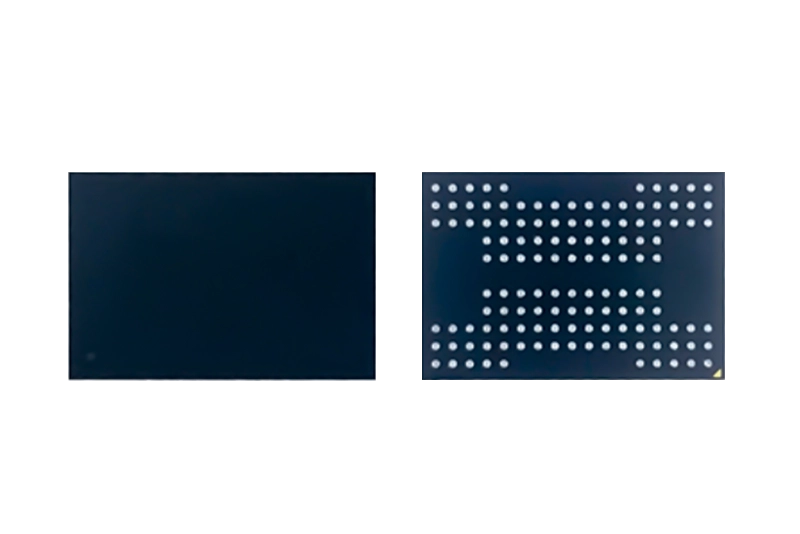
NAND Flash Storage Chip
- ONFI 4.0 standard interface
- TLC type with up to 3000 P/E
- BGA132 and BGA152 packages
NAND Flash
- Complies with ONFI 4.0
- TLC type, 3000 P/E cycles
- I/O speed up to 800 MB/s
Related resources
Continue with related selection guides and notes for the same industrial memory topic.
Quick answers
Common engineering questions answered up front.
What is the difference between eMMC and raw NAND flash in embedded systems?
eMMC is a managed NAND solution: it integrates raw NAND flash with a controller that handles wear leveling, bad block management, ECC, and a standardized eMMC 5.1 host interface. Raw NAND flash requires the host SoC to implement these functions in software or FPGA logic. eMMC simplifies design and shortens time-to-market; raw NAND offers lower BOM cost at scale and direct control over the flash.
When should I choose eMMC instead of raw NAND flash plus an external controller?
Choose eMMC when you want a validated storage subsystem with a standard interface, faster firmware bring-up, and lower engineering risk - typical for embedded Linux/Android boards, HMI, and gateways. Choose raw NAND when volume is high enough to amortize controller/FPGA development and you need to optimize cost or implement a custom NAND management scheme.
Is raw NAND flash cheaper than eMMC for high-volume designs?
At high volume, raw NAND plus an in-house or FPGA controller can have a lower unit cost than a managed eMMC package, because you remove the dedicated controller die and license fees. The trade-off is engineering cost: you must implement wear leveling, ECC, bad-block handling, and power-loss management yourself, which adds months of development and validation effort.
How does eMMC handle wear leveling and bad block management compared to raw NAND?
eMMC handles wear leveling, bad block management, ECC, and read/write reordering inside the device controller, transparent to the host. With raw NAND, the host must perform these functions, typically via an FTL (flash translation layer). The practical difference: eMMC guarantees consistent endurance behavior across the rated TBW with much less host-side engineering.
Can eMMC be used in industrial temperature (-40C to +85C) applications?
Yes. Industrial-grade eMMC devices are rated for -40C to +85C operation. Loongtion offers industrial eMMC (TLC) and pSLC eMMC options with wide-temperature support, including GJB-standard variants rated to -55C to +105C for defense and aerospace applications. Confirm the specific ordering PN and datasheet for your target environment.
Related cross-references
Pin-to-pin and functional alternatives referenced from this guide — for BOM review, dual-sourcing, or EOL coverage.