
DDR5 vs DDR4 for Industrial and Embedded Systems: A Practical Selection Guide
Introduction
Memory technology continues to evolve, and for industrial and embedded system designers, the choice between DDR4 and DDR5 has become a practical decision. While DDR4 remains a mature, cost-effective option, DDR5 introduces architectural changes that directly benefit bandwidth-hungry and thermally constrained applications. This guide compares the two technologies using data from the Loongtion DDR5 SDRAM datasheet and general DDR architecture principles to help you decide when DDR5 makes sense.
Key Architectural Differences
The shift from DDR4 to DDR5 is more than a speed bump. Several fundamental architecture changes affect performance, power, and system design.
Prefetch and Channel Architecture
DDR4 uses an 8-bit prefetch architecture with a single 64-bit channel per DIMM. DDR5 moves to an equivalent 16-bit prefetch by splitting each channel into two independent 32-bit sub-channels. Each sub-channel has its own command and address bus, allowing simultaneous operations that improve fine-grained concurrency. This is particularly beneficial in multi-threaded or real-time control applications.
Operating Voltage
DDR4 standard operating voltage is 1.2V. DDR5 reduces it to 1.1V (VDD/VDDQ), with a tolerance range of 1.067V (-3%) to 1.166V (+6%). The VPP supply remains at 1.8V. The lower core voltage directly reduces dynamic and static power consumption.
Power Management Integration
DDR5 moves the voltage regulation onto the module itself via an integrated Power Management IC (PMIC). This provides finer voltage control, faster transient response, and reduced noise compared to motherboard-based regulation used in DDR4. For industrial systems, this means more stable operation across temperature and load variations.
On-Die ECC
DDR5 includes on-die Error Correcting Code (ECC) that can correct single-bit errors within the DRAM chip itself. This improves reliability without requiring system-level ECC support. DDR4 relies entirely on external ECC (if implemented) or has no error correction. For industrial applications where data integrity is critical, on-die ECC offers a significant advantage.
Power and Thermal Considerations
Industrial systems often operate in wide temperature ranges and demanding thermal environments. The Loongtion DDR5 datasheet specifies operating case temperature (TCASE) of 0°C to 95°C for standard parts. Additionally, Loongtion offers two temperature-grade variants:
- YC5GG16W-9CXDQ-M: -25°C to +85°C
- YZ5GG16W-9CXDQ-M: -40°C to +85°C
These extended temperature ranges cover most industrial and outdoor applications. The lower core voltage of 1.1V (vs DDR4 1.2V) reduces power dissipation, making thermal management easier. DDR5 also supports fine-granularity refresh modes that adjust refresh rate based on temperature: 2x refresh (0°C to 85°C) and 4x refresh (85°C to 95°C), which helps balance data retention and power.
While the datasheet does not provide direct IDD current numbers for DDR4 comparison, the voltage reduction alone yields approximately 8% lower dynamic power at the same current. Combined with process improvements, DDR5 modules typically consume less power per gigabyte transferred.
Bandwidth and Latency
DDR5 starts at 4800 MT/s and scales beyond 6400 MT/s. Loongtion DDR5 parts are available at speeds of 4800, 5600, and 6400 MT/s. DDR4 tops out at 3200 MT/s for standard JEDEC specifications. The raw bandwidth increase is significant: a single DDR5-6400 module delivers up to 51.2 GB/s per channel, compared to 25.6 GB/s for DDR4-3200.
Latency, however, is more nuanced. The CAS latency (CL) in clock cycles is higher for DDR5: CL40 at 4800 MT/s, CL46 at 5600, CL52 at 6400. But because the clock period is shorter, the absolute time (in nanoseconds) is similar:
| Speed Grade | CL | tCK (ns) | tCL (ns) | |-------------|----|----------|----------| | DDR5-4800 | 40 | 0.416 | 16.6 | | DDR5-5600 | 46 | 0.357 | 16.4 | | DDR5-6400 | 52 | 0.313 | 16.3 | | DDR4-3200 | 22 | 0.625 | 13.75 |
As shown, DDR5 CAS latency in ns is slightly higher than DDR4, but within a similar range. Other timing parameters like tRCD (RAS-to-CAS delay) and tRP (row precharge delay) are specified as 16 ns for DDR5-4800/5600/6400. For many applications, the bandwidth increase outweighs the slightly higher latency, especially for data-intensive workloads.
Reliability Features
Industrial systems require high reliability. DDR5 includes several features not present in DDR4:
- On-die ECC: Corrects single-bit errors inside the DRAM, reducing system error rates.
- CRC (Cyclic Redundancy Check): Supports read and write data integrity checking.
- Decision Feedback Equalizer (DFE): 4-tap DFE improves signal integrity at high speeds, especially on longer traces.
- Per-Pin VREFDQ Training: Allows per-DQ-pin voltage reference calibration for better noise margins.
- Connectivity Test Mode (TEN): Facilitates board-level testing.
These features are documented in the Loongtion DDR5 datasheet. DDR4 lacks DFE and on-die ECC, and CRC support is optional and rarely implemented.
Migration Considerations
Moving from DDR4 to DDR5 is not a drop-in replacement. Key differences include:
- Pinout and Package: DDR5 uses different ball assignments. x4/x8 devices use an 82-ball WBGA package, while x16 uses 102-ball WBGA. DDR4 packages are different.
- Power Delivery: DDR5 requires PMIC on the module, so the motherboard must provide only the raw supply voltage (typically 5V or 12V for the PMIC). DDR4 modules receive 1.2V directly.
- PCB Layout: Higher data rates demand tighter signal integrity design. DDR5's DFE helps, but trace lengths, impedance control, and crosstalk management become more critical.
- Memory Controller Support: The SoC or CPU must have a DDR5 memory controller. Many industrial processors still rely on DDR4, so check your platform's capabilities.
For new designs targeting high bandwidth, long product life, and industrial temperature ranges, DDR5 is worth the investment. For cost-sensitive or legacy designs, DDR4 remains viable.
Loongtion DDR5 Product Offerings
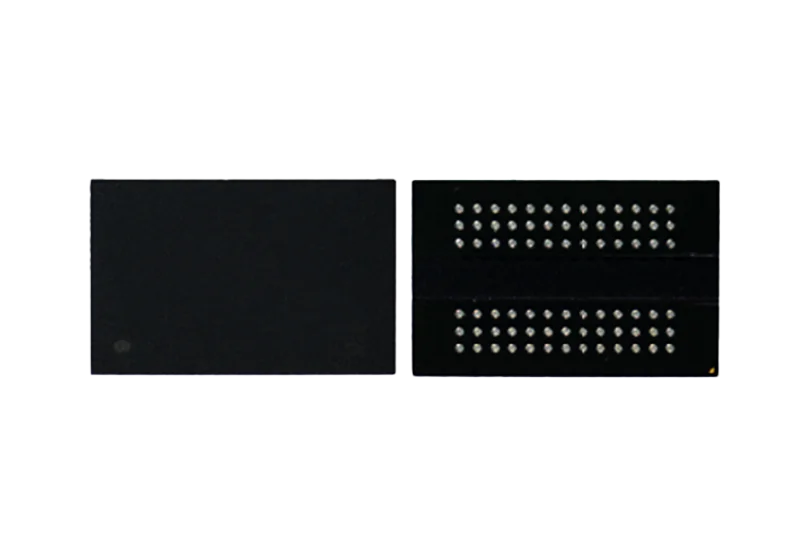
Based on the datasheet, Loongtion offers 16Gb DDR5 components in the following configurations:
| Density | Configuration | Package | Part Number | Temp Range | |---------|---------------|---------|-------------|------------| | 16Gb | 2Gb × 8 | WBGA-82 | YC5GG16W-9CXDQ-M | -25°C to +85°C | | 16Gb | 2Gb × 8 | WBGA-82 | YZ5GG16W-9CXDQ-M | -40°C to +85°C |
Both parts are based on CXMT (Hefei ChangXin) wafers and are qualified for industrial and embedded applications. The datasheet covers speeds up to 6400 MT/s with standard timing parameters.
Conclusion
Choose DDR5 for industrial designs when:
- You need bandwidth exceeding DDR4's 25.6 GB/s per channel.
- Lower operating voltage (1.1V) helps meet power budgets.
- Extended temperature range (-40°C to +85°C) is required.
- On-die ECC and advanced signal integrity features improve reliability.
- The platform supports DDR5 memory controllers and PMIC-based power delivery.
Stick with DDR4 when:
- Cost is the primary driver and bandwidth requirements are moderate.
- The existing design uses DDR4 and migration is not feasible.
- The processor or FPGA only supports DDR4.
Loongtion's DDR5 product line offers industrial-grade components with documented specifications, making the transition to DDR5 practical for embedded engineers who need higher performance without sacrificing reliability.
Related products
Shortlist lines referenced in this guide — open the product page for PN, grades, and datasheet request.
Related resources
Continue with related selection guides and notes for the same industrial memory topic.
Related cross-references
Pin-to-pin and functional alternatives referenced from this guide — for BOM review, dual-sourcing, or EOL coverage.