
Industrial DDR4 Selection Basics for Embedded Designs
Introduction
Selecting the right DDR4 memory for an industrial or embedded design goes beyond frequency and capacity. Temperature range, error handling, packaging, and signal integrity all affect long-term reliability. This guide walks through the critical decision points using JEDEC specifications and Loongtion's industrial DDR4 SDRAM family as a reference.
Temperature Grades
Industrial environments demand wider temperature tolerance than commercial parts. DDR4 SDRAM is typically specified in three operating temperature ranges:
| Grade | Temperature Range (Case) | Typical Use Case | |-------|--------------------------|------------------| | Commercial | 0°C to +85°C | Office, consumer | | Industrial | -40°C to +95°C | Factory, outdoor | | Wide Temp / Extreme | -55°C to +105°C | Aerospace, military |
Loongtion's 8GB DDR4 SDRAM is offered in two temperature variants (see product table):
- -I (Industrial): -40°C to +85°C (standard refresh tREFI = 7.8 µs). Operation up to +95°C is supported with tREFI = 3.9 µs (85°C to 95°C range). Confirm thermal model with vendor before production use above +85°C.
- -M (Wide Temperature / Extreme): -55°C to +105°C case temperature.
When designing for high-temperature operation, note that the refresh rate must be doubled (tREFI halved) above 85°C to maintain data integrity. Always verify your system's thermal profile against the memory's specified case temperature, not ambient.
ECC vs. Non-ECC
Error Correcting Code (ECC) memory is critical in applications where data corruption cannot be tolerated—such as industrial controllers, networking equipment, and edge servers.
- Non-ECC DDR4: Standard DDR4 modules do not include on-chip ECC. Loongtion's 8GB DDR4 SDRAM supports command/address (CA) parity and write CRC (Cyclic Redundancy Check) on the data bus, which can detect but not correct errors. These features reduce the chance of undetected errors but do not provide single-bit correction.
- System-Level ECC: External ECC is typically implemented by the memory controller (e.g., on SoCs or FPGAs) using additional data bits (e.g., 64-bit data + 8-bit ECC). This requires a wider bus and a controller that supports ECC. The DDR4 DRAM itself is the same; only the module or chip arrangement differs.
- On-Die ECC: DDR5 introduced on-die ECC to correct internal single-bit errors. DDR4 does not have this feature.
For industrial designs requiring high reliability, use a memory controller with ECC support and account for the extra bytes in your system design. Loongtion's DDR4 components are fully compatible with system-level ECC implementations.
Form Factors
DDR4 memory is available in several physical forms. For embedded designs, discrete DRAM chips are often mounted directly on the PCB, while modules (DIMMs, SO-DIMMs) are used in slot-based systems.
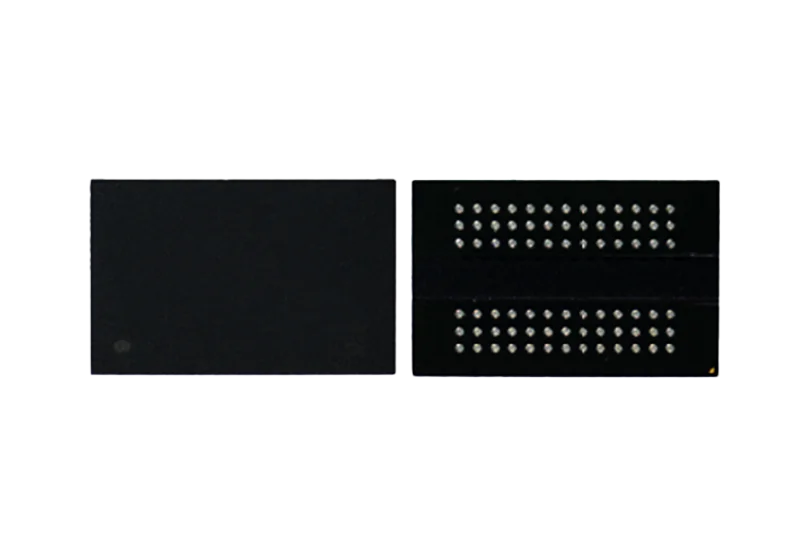
Loongtion's 8GB DDR4 SDRAM is offered in two FBGA packages:
| Configuration | Package | Balls | Dimensions (mm) | |---------------|---------|-------|------------------| | 1G x 8 (8Gb) | FBGA78 | 78 | 9.0 x 14.0 x 1.2 | | 512M x 16 (8Gb) | FBGA96 | 96 | 9.0 x 14.0 x 1.2 |
When selecting a package, consider:
- Width: x8 parts are common for server applications (8-bit data per chip); x16 parts reduce chip count for narrower buses.
- Pin-out: The 78-ball and 96-ball have different ball maps. Verify PCB layout compatibility.
- Density: 8Gb per chip allows 8GB modules using eight x8 chips (plus ECC if needed).
For module-based designs, DDR4 modules come in 288-pin UDIMM, 260-pin SO-DIMM, and other form factors. Loongtion's DRAM components are suitable for building such modules, but always confirm the specific module part number for your application.
Industrial Reliability Factors
Beyond temperature, several DDR4 features enhance reliability in harsh conditions:
- On-Die Termination (ODT): DDR4 supports dynamic ODT, which can be configured per write cycle. This reduces signal reflections on the bus, improving signal integrity at high frequencies.
- ZQ Calibration: An internal calibration process (ZQ) adjusts the output driver strength and ODT values to compensate for process, voltage, and temperature variations. Loongtion's parts support ZQ calibration.
- DLL-Off Mode: Disabling the Delay-Locked Loop (DLL) at low frequencies saves power and can be used in special low-speed modes.
- CA Parity: Protects command and address signals against transient errors. Loongtion's DDR4 supports CA parity mode.
- Write CRC: Detects errors on the data bus during write operations.
- Data Bus Inversion (DBI): Reduces power and switching noise by inverting the data bus when the number of 1s exceeds a threshold.
- Asynchronous Reset: Allows a clean reset of the DRAM state without power cycling.
- Low-Power Self-Refresh: Maintains data with minimal power during system sleep states.
Power Supply Requirements
DDR4 operates from three supplies:
- VDD = VDDQ = 1.2V ± 0.06V
- VPP = 2.5V (2.375V–2.75V) for wordline boost
Proper sequencing and decoupling are mandatory. The power-up initialization sequence must follow JEDEC guidelines to avoid undefined states. Loongtion's datasheet provides detailed timing for VDD and VDDQ ramp.
Signal Integrity Considerations
High-speed DDR4 (up to 3200 MT/s) requires careful PCB design:
- Controlled impedance traces (typically 40–60 Ω single-ended).
- Differential clock (CKt/CKc) routing with matched lengths.
- Termination for command/address and data lines (ODT or external resistors).
- Avoid stub routing on fly-by topology.
Loongtion's datasheet includes AC/DC input levels, overshoot/undershoot limits, and slew rate requirements that your design must meet.
Speed Grades and Timing
DDR4 speed grades are defined by data rate (MT/s). Loongtion's 8Gb DDR4 supports up to DDR4-3200 (3200 MT/s). The speed grade table in the datasheet lists supported combinations of CL (CAS latency), tRCD, tRP, and tRAS for each frequency. Common industrial choices:
| Speed Grade | Data Rate (MT/s) | CL | Typical Use | |-------------|------------------|----|-------------| | DDR4-2400 | 2400 | 17 | Balanced power/performance | | DDR4-2666 | 2666 | 19 | Mid-range embedded | | DDR4-3200 | 3200 | 22 | Maximum bandwidth |
Lower frequencies often yield better timing margins and lower power, which may be preferable in thermally constrained environments.
Summary Checklist for Industrial DDR4 Selection
- Temperature: Define your case temperature range. Choose -I or -M grade accordingly. Plan for extended refresh above 85°C.
- ECC: Decide if system-level ECC is needed. Ensure the memory controller supports it.
- Density and Organization: Select x8 or x16 chips based on bus width and board space.
- Package: Verify footprint compatibility (78-ball vs 96-ball).
- Speed Grade: Balance bandwidth with power and signal integrity constraints.
- Reliability Features: Enable CA parity and write CRC for additional protection.
- Power Supply: Design for 1.2V (VDD/VDDQ) and 2.5V (VPP) with proper sequencing.
- Thermal Management: Confirm airflow or heatsinking to keep DRAM case temperature within limits.
Always consult the latest Loongtion DDR4 SDRAM datasheet for up-to-date specifications, especially for timing parameters and initialization sequences.
Related products
Shortlist lines referenced in this guide — open the product page for PN, grades, and datasheet request.
Related resources
Continue with related selection guides and notes for the same industrial memory topic.
Related cross-references
Pin-to-pin and functional alternatives referenced from this guide — for BOM review, dual-sourcing, or EOL coverage.