
LPDDR4X Embedded Design: Architecture, Power, and Layout for Industrial Systems
Introduction
LPDDR4X is the low-power evolution of DDR4, optimized for bandwidth and energy efficiency in space-constrained embedded systems. Loongtion's LPDDR4X SDRAM family uses wafers from ChangXin Memory Technologies and is available in industrial and extended temperature grades. This article covers the architecture, electrical characteristics, thermal considerations, signal integrity, and layout guidelines needed to integrate LPDDR4X into an embedded design for industrial applications.
Architecture and Dual-Channel Operation
LPDDR4X employs a dual-channel architecture with separate clock, command/address, and data buses per channel (A and B). Each channel is 16 bits wide, for a total of 32 bits per device. The 8n-prefetch and multi-bank design deliver high throughput while keeping the I/O voltage at 0.6 V – half of standard DDR4. Key features from the datasheet include:
- Multi-channel: Two independent 16-bit channels per package.
- Low-voltage I/O: VDDQ = 0.6 V typ (0.57 V–0.65 V) reduces switching power.
- Deep Sleep Mode: Further power saving when idle.
- On-die termination (ODT): Fully controlled via mode registers; the ODT_CA pin is ignored on LPDDR4X – tie it to VDD2 or VSS for mechanical stability.
Note that the 2 GB part (part numbers YZDB5CCBM-EA-A and YZDB5CCBM-EA-A) has one channel (B) not connected – CS1A/B, CE1A/B, and ZQ1 are no-connects. For these devices, only channel A is available, effectively operating as a 16-bit wide memory. The 4 GB and 8 GB parts use both channels.
Power Rails and Decoupling
The device requires three supply voltages:
| Voltage | Symbol | Min (V) | Typ (V) | Max (V) |
|---|---|---|---|---|
| Core 1 | VDD1 | 1.70 | 1.80 | 1.95 |
| Core 2 | VDD2 | 1.06 | 1.10 | 1.17 |
| I/O | VDDQ | 0.57 | 0.60 | 0.65 |
These rails must be sequenced per JEDEC guidelines: VDD1 and VDD2 should ramp simultaneously or VDD1 first, followed by VDDQ. The ultra-low VDDQ demands careful power delivery network (PDN) design to keep ripple below 30 mV peak-to-peak. Use at least four decoupling capacitors per voltage rail, placed as close as possible to the package balls. Recommended capacitor values: 0.1 µF and 1 µF in parallel for each rail, with additional bulk capacitance on VDD1 (10 µF or more).
Data rates reach 4266 MT/s (LPDDR4X-4266) with CAS latencies programmed via mode registers. At these speeds, signal integrity on the CA and DQ buses is critical.
Temperature Grades and Thermal Derating
Loongtion offers two temperature ranges:
| Grade | Temperature Range | Part Number Suffix |
|---|---|---|
| Standard | –40 °C to +85 °C | YZDB... (without suffix 0) |
| Extended | –55 °C to +105 °C | YZDB… |
Operation above +85 °C case temperature requires derating: the refresh period (tREFI) must be halved, and AC timing parameters may need derating per the datasheet. The internal temperature sensor (monitored via MR4) can automate this, but the system designer must ensure adequate cooling for sustained +105 °C operation. The extended-temperature parts (YZDB prefix) are qualified for continuous operation up to +105 °C, but derating still applies above +85 °C.
For designs operating near the upper limit, consider using a heat sink or forced airflow. The package thermal resistance (not specified in available documentation) should be evaluated with your thermal simulation.
Package and PCB Layout Guidelines
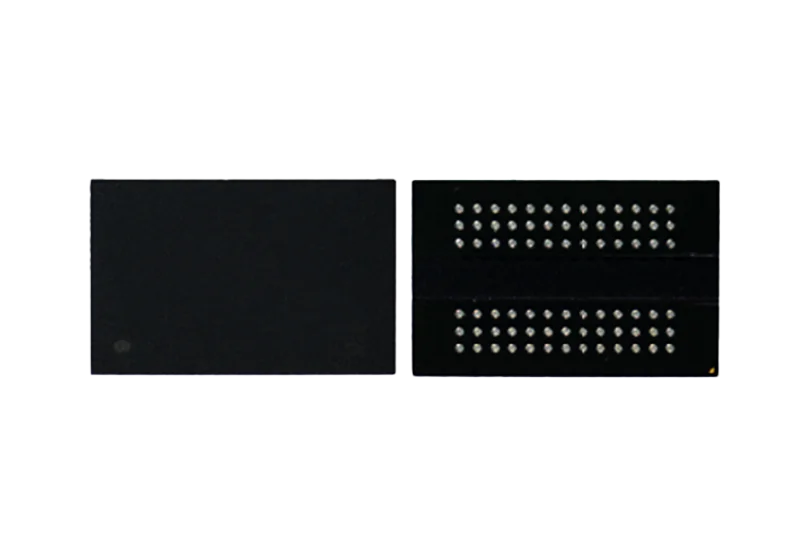
The LPDDR4X uses a 200-ball FBGA package (15 mm × 10 mm × 0.95 mm). The ball pitch is 0.80 mm on the X-axis and 0.65 mm on the Y-axis. Two channels are routed on opposite sides of the package, and the pinout follows JEDEC with dedicated VDDQ, VDD1, and VDD2 balls.
Key layout guidelines:
- Route DQ, DQS, and DMI signals as matched-length groups per byte lane. Length mismatch within a byte group should be kept under 5 mm to minimize skew.
- Keep CKt/CKc differential impedance at 100 Ω ±10% and route them with a solid reference plane.
- Connect ZQ pin to VDDQ through a 240 Ω ±1% resistor. Place this resistor within 10 mm of the ball.
- ODT_CA pins are no-connects for LPDDR4X; tie them to VDD2 or VSS for mechanical stability.
- Use at least four decoupling capacitors per voltage rail, placed within 5 mm of the package. Prefer 0402 or smaller packages to reduce inductance.
- Maintain a solid ground plane on the layer adjacent to the signal routing.
Signal Integrity and Training
At 4266 MT/s, signal integrity is paramount. LPDDR4X incorporates several training mechanisms to ensure reliable operation:
- Write leveling: Compensates for DQS-to-CK skew. The controller must enable write leveling during initialization and use the tWLDQSEN timing parameters provided in the datasheet.
- Read and write training: The DQS signals require per-byte training to align with data eyes. The controller issues training commands (MPC) and adjusts delays based on the results.
- ODT programming: Use mode registers MR11 and MR22 to set RTT values for DQ and CA respectively. Typical values: RTTNom = 60 Ω for DQ, and RTTCA = 120 Ω for command/address.
- ZQ calibration: Perform ZQ calibration at power-up and periodically (every 1 s or as needed). The external 240 Ω resistor must be 1% tolerance.
Improper training can lead to data corruption. Always implement the full training sequence described in the datasheet sections on bus command training timing and write leveling timing.
Product Selection Guide
| Capacity | Part Number | Package | Data Rate (MT/s) | Temperature |
|---|---|---|---|---|
| 2 GB | YZDB5CCBM-EA-A | FBGA200 | 3733/4266 | –55 °C to +105 °C |
| 4 GB | YZDB6CCBM-EA-A | FBGA200 | 3733/4266 | –55 °C to +105 °C |
| 2 GB | YZDB5CCBM-EA-A | FBGA200 | 3733/4266 | –40 °C to +85 °C |
| 4 GB | YZDB6CCBM-EA-A | FBGA200 | 3733/4266 | –40 °C to +85 °C |
| 8 GB | YZDB7CCDM-EA-A | FBGA200 | 3733/4266 | –40 °C to +85 °C |
All parts are dual-channel, single-rank per die. The 2 GB devices have one channel no-connect (CS1, CE1, ZQ1 are NC). The 8 GB part stacks two dies internally; its pinout is identical.
For updated availability and alternative packages, consult the latest Loongtion product page at industrial memory chips.
Embedded Design Checklist
- Power sequencing: Ensure VDD1, VDD2, and VDDQ ramp within JEDEC limits. Loongtion recommends following the power-up sequence in the datasheet section 6.1.
- ZQ calibration: Perform ZQ calibration at initialization and periodically. The external 240 Ω resistor must be 1% tolerance, placed close to the ZQ ball.
- Write leveling: Enable write leveling to compensate for DQS-to-CK skew. The datasheet provides timing parameters for tWLDQSEN.
- ODT programming: Use MR11 and MR22 to set RTT values. LPDDR4X ignores the ODT_CA pin, so all CA ODT is controlled via registers.
- Thermal monitoring: Read the temperature sensor via MR4 to adapt refresh rate if operating above +85 °C. For continuous +105 °C, use extended-range parts (YZDB prefix).
- DQS training: Perform read and write training per JEDEC to align DQS with data. The controller must support the necessary training commands.
- Decoupling: Place at least four capacitors per voltage rail within 5 mm of the package. Use low-ESL capacitors (0402) for VDDQ.
- Layout review: Verify matched-length routing for each byte lane, differential impedance for clocks, and solid reference planes.
For more detailed application notes and reference designs, visit the Loongtion industrial memory chips page.
Conclusion
LPDDR4X offers a winning combination of bandwidth and power efficiency for embedded systems. By understanding the voltage domains, thermal constraints, layout demands, and training requirements, engineers can successfully integrate these devices into industrial designs. Always consult the latest datasheet for timing and configuration details.
For related products and specifications, see the product line.
Related products
Shortlist lines referenced in this guide — open the product page for PN, grades, and datasheet request.
Related resources
Continue with related selection guides and notes for the same industrial memory topic.
Related cross-references
Pin-to-pin and functional alternatives referenced from this guide — for BOM review, dual-sourcing, or EOL coverage.