
Industrial Temperature NVMe SSDs: Architecture, Selection, and Thermal Considerations
Operating Temperature Range and Industrial Grading
Industrial embedded systems often face extreme thermal environments – from unheated enclosures in winter to hot factory floors. For NVMe SSDs to function reliably, the storage device must be rated for the full ambient temperature span. Loongtion's industrial-grade (Grade I) NVMe SSDs are specified with an operating temperature range of -40°C to 85°C and storage temperature range of -45°C to 90°C, as documented in both the M.2 2280 NVMe SSD Data Sheet (DRAM Cache) and the M.2 NVMe SSD (cacheless) Data Sheet.
This wide temperature rating covers the majority of industrial, automotive (non-cabin), and outdoor embedded applications. Note that the temperature specification refers to ambient or case temperature; actual NAND flash junction temperature may be higher under sustained write workloads. Engineers should account for system-level airflow and heatsinking to keep the drive within its rated window. This article provides a deep dive into the architectural differences, power and thermal characteristics, and selection criteria for industrial-temperature NVMe SSDs.
Architecture: DRAM Cache vs. Cacheless Designs
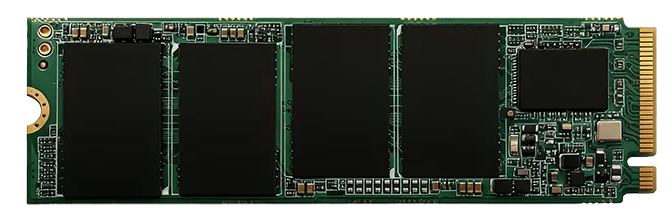
Loongtion offers two NVMe SSD families aimed at industrial use: a DRAM-cache version and a cacheless (DRAM-less) version. Both use a China-domestic controller and TLC NAND flash with 3000 P/E cycles, but their architecture differs in ways that affect performance and power.
DRAM Cache (M.2 2280 NVMe SSD)
- Onboard DRAM (Micron or CXMT) with approximately 1 GB per 1 TB of SSD capacity
- Interface: PCIe 3.0 x4, NVMe 1.4
- Capacities: 1 TB to 8 TB
- Sequential read: up to 2900 MB/s (8 TB), write: up to 2600 MB/s
- Power: idle 0.5–0.8 W, max sequential write 2.4–8.8 W (varies by capacity)
- Weight: <20 g, dimensions 80×22 mm (2280 form factor)
The DRAM cache provides a high-performance buffer for mapping tables and write coalescing, resulting in more consistent random I/O performance. This suits applications with mixed workloads or heavy random access (e.g., database logging, edge AI).
Cacheless (DRAM-less) NVMe SSD
- DRAM-less design (controller uses HMB or small on-chip SRAM)
- Capacities: 256 GB to 2 TB (2280); 2242 form factor up to 1 TB
- Sequential read: up to 2500 MB/s (2 TB), write: up to 1800 MB/s
- Power: idle 0.4 W, max sequential write 0.99–1.495 W – significantly lower than the DRAM version
- Lighter thermal load makes it ideal for passively cooled or space-constrained systems
The cacheless architecture reduces both cost and power dissipation. For read-intensive or sequential workloads (e.g., surveillance storage, data logging), it offers a favorable trade-off.
Power Consumption and Thermal Management
Thermal design is critical for industrial NVMe SSDs. The power figures below are taken directly from Loongtion datasheets and represent typical values at nominal voltage.
DRAM Cache Model (M.2 2280)
| Capacity | Sleep | Idle | Seq. Read Max | Seq. Write Max |
|---|---|---|---|---|
| 1 TB | 0.4 W | 0.5 W | 1.5 W | 2.4 W |
| 2 TB | 0.4 W | 0.6 W | 3.5 W | 3.7 W |
| 4 TB | 0.4 W | 0.8 W | 5.4 W | 5.5 W |
| 8 TB | 0.4 W | 0.8 W | 7.8 W | 8.8 W |
Cacheless Model
| Capacity | Sleep | Idle | Seq. Read Max | Seq. Write Max |
|---|---|---|---|---|
| 256 GB | 0.300 W | 0.415 W | 1.250 W | 0.990 W |
| 512 GB | 0.317 W | 0.400 W | 1.320 W | 1.120 W |
| 1 TB | 0.310 W | 0.400 W | 1.430 W | 1.180 W |
| 2 TB | 0.300 W | 0.400 W | 1.650 W | 1.495 W |
For applications with sustained writes near the maximum power, a heatsink or forced airflow is recommended to keep the drive within the industrial temperature range. The cacheless family offers roughly half the write power of the DRAM version, which can simplify thermal design. In passively cooled enclosures, the cacheless models are preferable to avoid thermal throttling.
Practical Thermal Design Tips
- Ensure adequate airflow across the SSD; even 1–2 m/s forced air can reduce case temperature by 10–15°C.
- Use thermal pads to transfer heat from the controller and DRAM to a metal chassis or heatsink.
- Monitor drive temperature via S.M.A.R.T. attribute 194 (Temperature) during worst-case workloads.
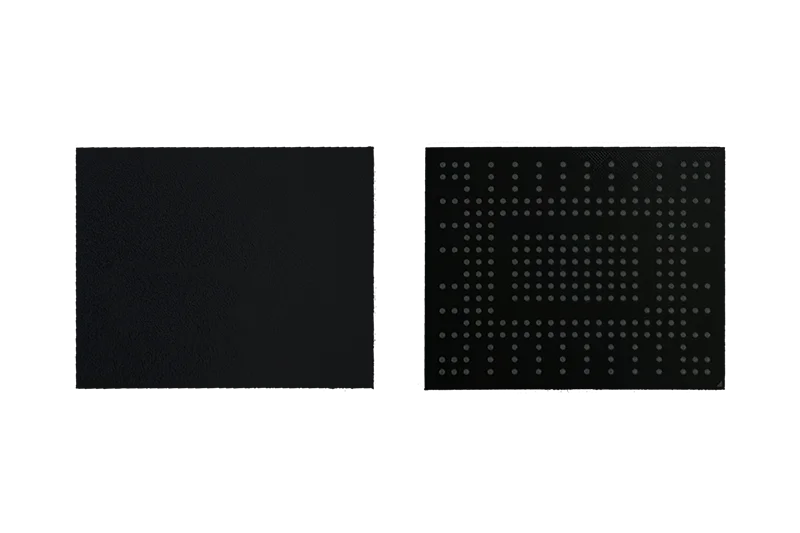
- For BGA packages (soldered on PCB), design PCB copper pours under the drive to spread heat.
Form Factors and Selection Criteria
Loongtion industrial NVMe SSDs are available in M.2 2280 (both DRAM and cacheless), M.2 2242 (cacheless only), and BGA 291 packages. The BGA option is documented in the NVMe BGA SSD Hardware Design Guide and is intended for embedded designs where the SSD is soldered directly on the PCB.
Key selection factors:
- Thermal environment: If the system has poor airflow, prefer cacheless models to minimize heat.
- Write intensity: For write-heavy workloads, the DRAM cache version provides more consistent performance and higher endurance (TBW).
- Capacity requirement: DRAM version supports up to 8 TB; cacheless up to 2 TB.
- Form factor: 2242 and BGA suit space-constrained designs; 2280 is standard for most embedded boards.
Endurance (TBW) per datasheet:
| Capacity | DRAM Cache | Cacheless |
|---|---|---|
| 256 GB | – | 180 TB |
| 512 GB | – | 360 TB |
| 1 TB | 400 TB | 720 TB |
| 2 TB | 800 TB | 1400 TB |
| 4 TB | 1600 TB | – |
| 8 TB | 3200 TB | – |
Application-Specific Selection Guidance
For surveillance systems with continuous sequential writes, the cacheless models offer sufficient throughput with minimal heat generation. For AI inference at the edge, where random reads dominate and DRAM cache improves latency, the DRAM version is recommended. In automotive telematics, where vibration and temperature extremes are present, the BGA package ensures reliable solder connections.
For custom embedded designs involving the BGA variant, the hardware design guide specifies strict power-on sequencing: 3.3 V must rise first (<3 ms), followed by 1.8 V and 1.2 V (1.2 V must rise <2 ms). RESET# releases ~3 ms after 1.2 V stabilizes. Power-down requires monotonic discharge below 100 mV before re-power. These details are critical and are fully covered in the guide.
All NVMe SSDs use a standard M.2 M-key connector or BGA interface, require 3.3 V supply, and support NVMe 1.4 protocol.
Firmware and Reliability Features
Loongtion industrial NVMe SSDs incorporate firmware-level features to ensure data integrity over the industrial temperature range:
- Wear leveling: Distributes writes evenly across NAND blocks to extend lifespan.
- Power-loss protection: High-reliability power management with short-circuit and undervoltage protection ensures data consistency during unexpected power loss.
- ECC: Advanced error correction to handle bit errors common at higher temperatures.
- TRIM/NCQ/S.M.A.R.T.: Supports standard command sets for performance optimization and health monitoring.
These features, combined with the wide temperature rating, make Loongtion SSDs suitable for mission-critical applications where data cannot be compromised.
Conclusion
Choosing the right industrial NVMe SSD hinges on matching the drive's thermal and power characteristics to the system's real-world environment. Loongtion's datasheets provide clear specifications for operating temperature, power, and endurance across both DRAM and cacheless families. Always validate with the latest datasheet for the specific part number and contact the manufacturer for application-specific thermal simulations or board layout recommendations.
For further guidance, refer to Loongtion's industrial memory chips landing page or the NVMe industrial SSD product page for detailed specifications and design resources.
Related products
Shortlist lines referenced in this guide — open the product page for PN, grades, and datasheet request.

M.2 2242 NVMe SSD (Cacheless)
- Dimensions
- Capacities from 512GB to 1TB
- Compatible with Industrial
M.2 2280 NVMe SSD (With Cache) · Wide-temp
- Independent DRAM cache
- PCIe 3.0×4 lane
- Compatible with Industrial
M.2 2280 NVMe SSD (Cacheless) · Wide-temp
- PCIe 3.0×4 Lanes
- Supports TRIM/NCQ/S.M.A.R.T
- Compatible with Industrial
Rugged NVMe SSD
- Adopts Samtec high-speed
- PCIe Gen3×4 lanes
- Adopts Kioxia Industrial TLC
NVMe BGA SSD · Wide-temp
- FBGA291 Package
- PCIe Gen3×4 Interface
- Environmental testing
Related resources
Continue with related selection guides and notes for the same industrial memory topic.
Related cross-references
Pin-to-pin and functional alternatives referenced from this guide — for BOM review, dual-sourcing, or EOL coverage.